

Reform and Remember

October turns over to November with two significant days that often get buried under a pile of Halloween candy. The 31st is Reformation Day, which remembers Martin Luther nailing 95 theses on the Wittenberg church door protesting the shortcomings he saw in the church of his day. This action is considered the symbolic catalyst for the Protestant Reformation, a movement that dramatically transformed not just the Christian church, but all of Western Civilization.

Then today is All Saints Day. If you want to get into the weeds concerning a church holiday (and I always do), some celebrate All Saints Day as a memory of all the faithful who have gone before us. Others celebrate solely the canonized saints and then remember the rest on All Souls Day the next day. Because of my priesthood-of-all-believers-confessing Baptist roots, I tend towards remembering everyone on the same day. The way I see it, the lessons I learn from St. Francis of Assisi and my Grandma are equally profound and important.

Reformation Day and All Saints Day hold together our past, present, and future. The animating force behind the Reformation is that the church should always be moving forward to God’s calling of us. Since we are all flawed individuals, the Christian institutions are always stumbling in the vocation of loving God and neighbor. Thus we always need to take sober stock of the church’s actions and reform for a more Christlike tomorrow. All Saints celebrates the hope, courage, conviction, and failures of past Christians who can illuminate that way forward.

This Could Possibly Be the Best Day Ever?

I made my way through our dimly lit house this morning in order to get our oldest son up and ready for virtual school. Before I could get upstairs, I saw something stir on the couch. There he was; fast asleep. At first I tried to gently rouse him but he merely just rolled over and continued to snore. Escalation was necessary. I lovingly rubbed and patted his back. I leaned into his ear and made funny noises. I took his blanket and pillow. Nothing.

Finally, I turned on the music playlist I made for him and his brother. Not too loudly—I’m not a monster—but enough to see if it got a response. The first song on the mix is the theme song to Phineas & Ferb, one of his favorite cartoons. At the first word, he shot up. He later admitted that he thought there was an episode on TV and didn’t want to miss it. We got our day started as the playlist carried on with songs about Perry the Platypus and odes to the Star Wars desert planet Tatooine.

But it was the chorus of that first song that has lingered with me:

This could possibly be the best day ever / and the forecast says that tomorrow will likely be a million and six times better / So make every minute count / Jump up, jump in, and seize the day / And let’s make sure that in every single possible way / Today is going to be a great day

We Are All Connected

Long voting lines aren’t that bad if you bring a book. Last Thursday, I found myself in a queue that wrapped around our local library’s parking lot before snaking in and out of the stacks. I had been warned and came prepared because there was no way that I wasn’t going to vote. I read and chatted with my neighbors in line each six feet to the other side of me: a Florida transplant and a Nashville native who recently returned home after being overseas.

It’s funny how connections can spring out of nothing but proximity. All we initially had in common was our place in line, but that was enough to pleasantly pass the time to talk about the state of the world, how different regions have responded to the pandemic, and whether hipsters still dominate East Nashville. In the lulls—as I thought about neighbors and an election that touches so many people—I finished my book. And this is one of the things I read:

All of us, part of the same body.
This is our body.
All of us entangled.

If a doctor tells you that there is something seriously wrong with your leg, you would not laugh and say,
Whatever.
You would be alarmed,
and you would seek help,
immediately.
Because what’s happening in one part of your body
inevitably affects the rest of your body because ultimately you have one
body.

Do This and You Will Live

I make up TV shows in my head all the time. I had this idea for one called God Cops. It would be a normal police procedural, but the crimes investigated were violations of the Ten Commandments.

Just imagine the “Good Cop, Bad Cop” interrogation of a man who allegedly did some work on the Sabbath. Or the precinct’s frustration when someone who used God’s name in vain is back on the street because the judge rules that commandment is more about misrepresenting God than an exclamation. Or a cool, aviator glasses-wearing, mustache-sporting detective sliding across the hood of the car to take down a perp looking covetously at his neighbor’s cow all while a funky guitar riff is punctuated by a blast of horns.

It would have been glorious and would have made so, so many people angry. The inspiration behind this satiric ridiculousness was that people often seem really eager to police religious adherence. It is as if their whole conception at the root of following God is a notion of crime and punishment. You obey the commandments so the Almighty doesn’t throw the book at you and there are scores of people who believe they are deputized to carry that out.

Angry Enough to Die

Jonah is a children’s Bible story staple because of its big fish. Someone decided long ago that if an animal is in a tale then it must be a great story to tell to kids. This is a terrible idea and Noah’s Ark is at the top of the list why. But Jonah has a large sea creature and he learns a lesson so we make that exclusive content of children’s church and don’t really pay it any heed as adults.

That’s a mistake because Jonah is a fascinating little story with a nasty little protagonist who learns a lesson yet not the lesson and a God who is filled to the brim with mercy.

When I was told this story in church as a kid, it was said that Jonah ran because he was scared. He didn’t want to go to Nineveh because he was afraid to deliver the message. This isn’t true; at least not how it was framed to me. Jonah says so himself. He ran because he was afraid that God would forgive the people of Nineveh and Jonah did not want to see that happen. This prophet would rather disobey God—risking his life and the life of some unwitting sailors at sea—than see people he considered his enemies receive grace and restoration.

This is a story we should read regularly as adults.

Making a Hole in the Ceiling (Luke 5:17-26)

In November of 1982, the SMU Mustangs defeated the Texas Tech Red Raiders when Bobby Leach caught a bouncing across-the-field lateral on a kickoff return and sprinted 91 yards to the end zone. An NFL assistant coach by the name of Alan Lowry saw that play and kept it in the back of his mind in case he ever needed to call up that kind of miracle. A little over 17 years later, it was time. The Buffalo Bills had just kicked a field goal to take the lead with 16 seconds left in their first round playoff matchup against the Tennessee Titans. The odds of getting through Buffalo’s special team to the end zone seemed slim. The Titans needed to get creative. They needed the play that Alan Lowry saw in Texas many years before.

If you are only passingly familiar with the Titans, you know what happened next. Lorenzo Neal fielded the kick, handed it to Frank Wycheck. Wycheck began running to his right, then turned, and tossed the ball across the field to Kevin Dyson who ran 75 yards for the touchdown and the victory. It was not only one of the most memorable endings ever for the Titans, but one of the all-time greatest finishes to a game in NFL history. Even I—who did not remotely care about the Titans at the time—can still remember where I was when I saw the Music City Miracle. It’s just a reminder that sometimes when your back is against the wall, you need to get creative and amazing things might happen.

There were once four individuals who were hoping for something amazing; not for themselves, but for their paralyzed friend. They had heard about this teacher, a rabbi from Nazareth named Jesus, who had the power to heal people. They had hoped that maybe he might be able to do something for their friend. So they put him on a mat and they carried him to the house where they heard this miracle worker had set up shop. Yet when they got to the place, their hearts sank. The building was slammed full. A massive crowd had gathered around Jesus filling every nook and cranny of the room and spilling outside the house. There was seemingly no way for them to get through all of those people and get their friend to Jesus.

Hold Fast

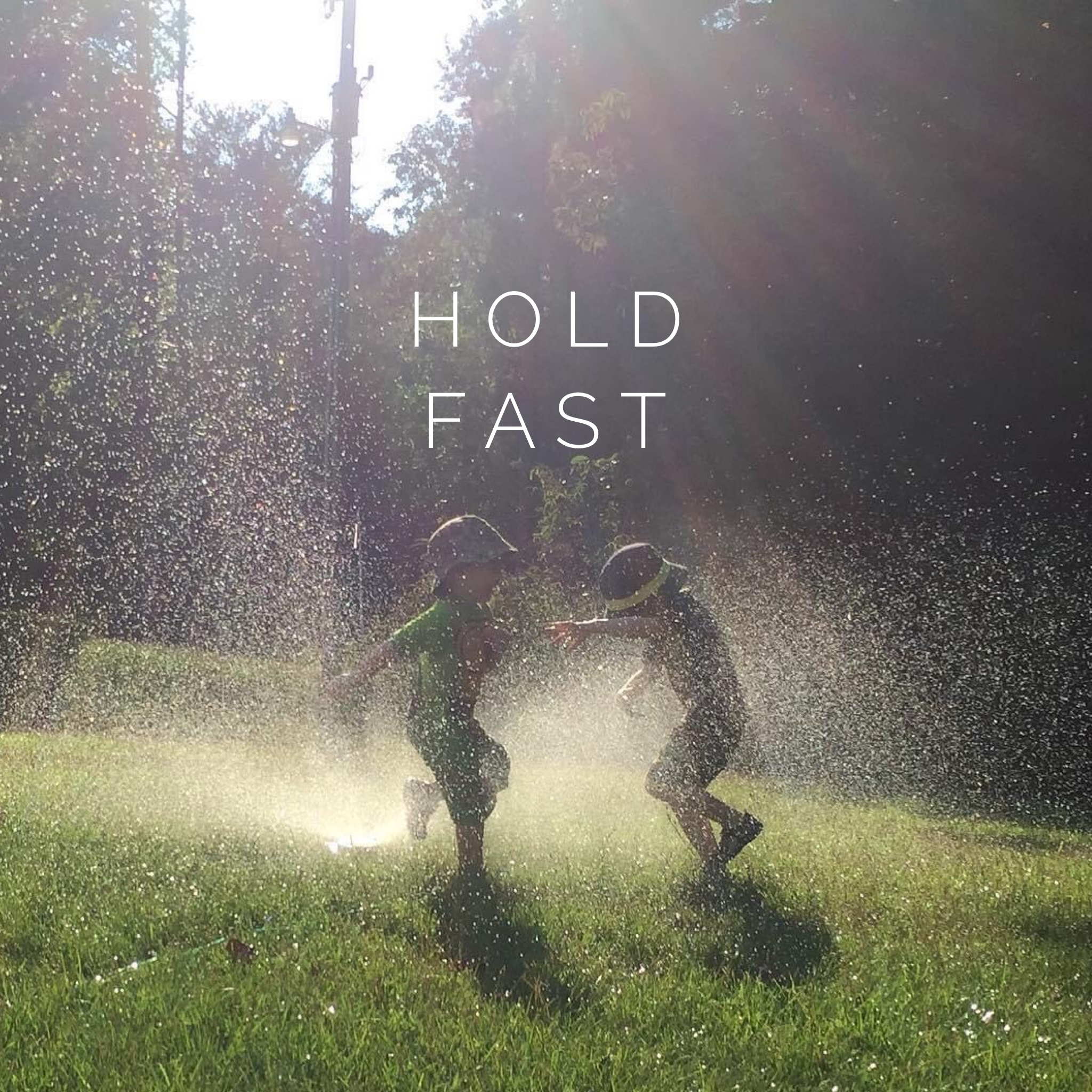
One of my favorite pictures ever of our two boys was taken in the final month before I moved to Tennessee. The two of them are dancing in the sprinkler in my parents’ yard. The sun beams down on them. And I know that it sounds cheesy, but it looked like every children’s Bible illustration of the Holy Spirit shining down. But instead of a just-baptized Jesus and a dove it was our 6 year old and 3 year old joyfully frolicking in the grass. Though that was not going to save the world, it still looks like God is saying, “This is good. With them I am well pleased.”

Even four years later, that picture never ceases to make me smile. There is something so joyous and pure and good about it. It captures a memory on to which I try to hold as much as I can. It’s one of those moments that reminds me why EA and I do this parent thing even though it often drives us up the wall these days.

Many years ago, Paul wrote that our love must be sincere and we must hate what is evil. But he had a third piece of instruction that feels like the engine that drives the other two: hold fast to the good. For us to have a love that is authentic and the strength to push back on the injustice that inflicts wounds on all of us, we need to cling to whatever good we find in the world.

The Sin That So Easily Entangles U.S.

Hebrews 12:1-2 says, “Therefore since we are surrounded by such a great cloud of witnesses, let us throw off every encumbrance and the sin that so easily entangles, and let us run with endurance the race set out for us. Let us fix our eyes on Jesus, the author and perfecter of our faith, who for the joy set before Him endured the cross, scorning its shame, and sat down at the right hand of the throne of God.”

This is Mike Pence’s remix of that verse from his speech on Wednesday night: “Let’s run the race marked out for us. Let’s fix our eyes on Old Glory and all she represents. Let’s fix our eyes on this land of heroes and let their courage inspire. And let’s fix our eyes on the author and perfecter of our faith and freedom and never forget that where the spirit of the Lord is there is freedom—and that means freedom always wins.”

I’m sure his aim was piety because his base loves the mingling of God and country. Yet let me say this very firmly and very clearly: This is not piety but idolatry. Centering this country and its flag into a passage that is about the Christ who laid down his life out of love for the entire world is wrong. There is no working around how wrong this is. This is Golden Calf level stuff here.

The Flood Has Not Swept Us Away

Tonight felt a little bit like the sun peaking through the clouds after a fearsome storm. Things will still not be normal for quite some time. The effects of the storm are ever present. To be honest, I don’t even know for sure if the storm has passed or we have just caught a break. I just know that right now there seems to be some daylight.

The last time that we met as a youth group was over five months ago. We filled the gaps where we could. We rode Zoom to the end of the school year. We made front porch visits in the summer. But like so much else in this year gone sideways, it was not the same. And today was still not the same. We met outside scattered around the church’s campus. We wore masks and kept our distance.

But we were together and, in the midst of chaos and the tumult of this year, that felt like a victory.

It also felt like a victory to create something new. Our youth and children’s ministries teamed up to put together a drive-in worship service for families. Beneath the late August sun, we sang and ran and danced and reminded those dear to us that we love them and God does too. It was gratifying to hatch this scheme with a great group of people, have no idea if anyone would show up, and then watch the parking lot fill with cars. That too felt like daylight.

Dogs and When Jesus Grew

Matthew 15:21-28 goes a little something like this:

Canaanite woman asks Jesus to heal her daughter. Jesus ignores her. Canaanite woman persists. Jesus implies Canaanite woman is a dog. Canaanite woman points out that even dogs get scraps. Jesus is impressed with the Canaanite woman’s response and heals her daughter.

Pardon?

This is the gospel passage for the Lectionary today. People have to actually preach on it. It’s a crazy passage because on the surface it undermines one of the most fundamental things that Christians have long believed about Jesus: that he was the compassionate, sinless human embodiment of God. Yet in this passage, he coldly shoots down the requests of a mother with a sick child; all because she was not one of his people.

²⁵ But she came and knelt before him, saying, “Lord, help me.” ²⁶ He answered, “It is not fair to take the children’s food and throw it to the dogs.”

That isn’t great! It’s disconcerting and troubling. It seemingly runs against a lot of what Jesus says/does when he encounters Gentiles in other passages. It seems to run counter Jesus preaching that we love our enemies. The problems are only amplified as we are presently having important cultural conversations about how certain people groups are discriminated against.