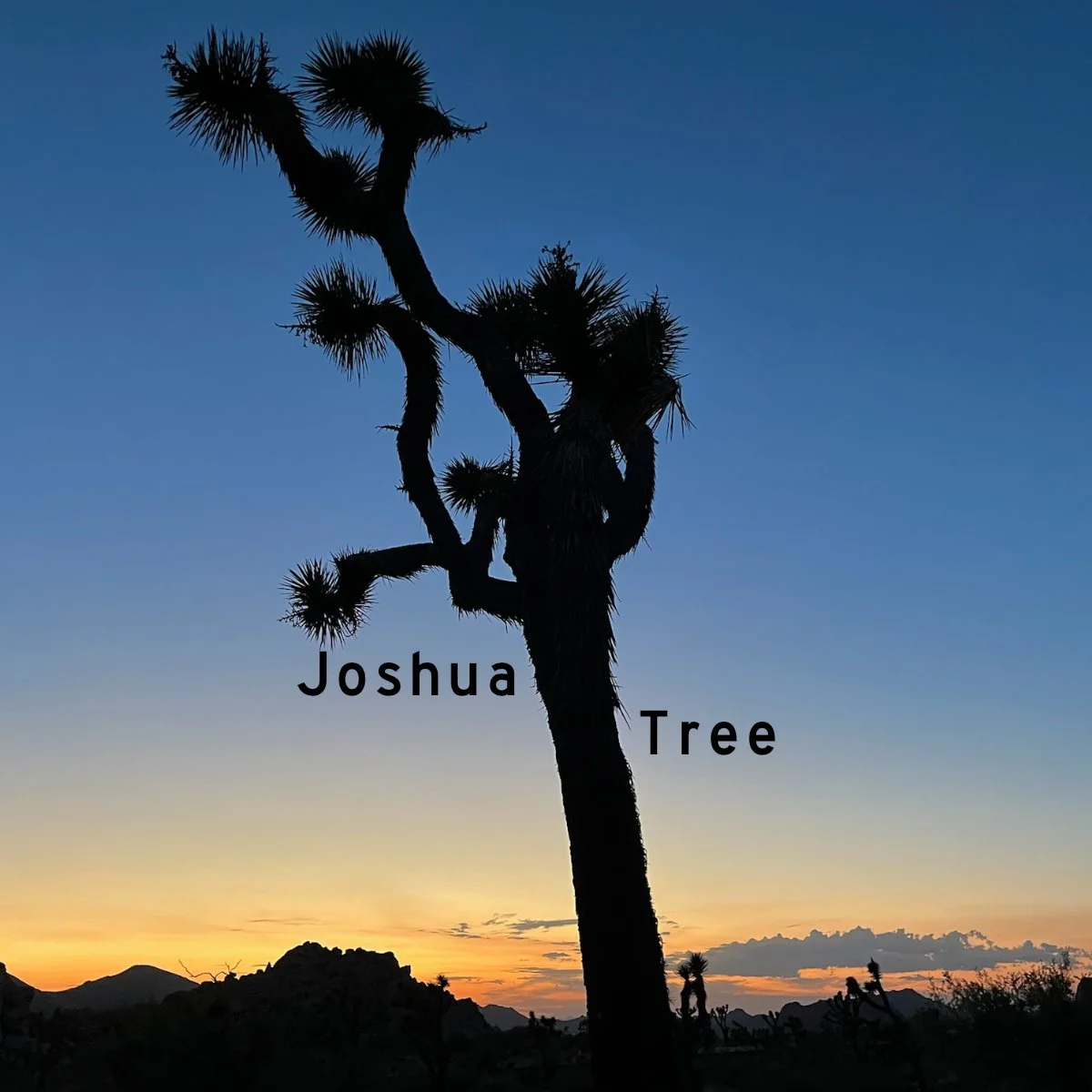
Have you ever been in a place so still that peace sinks down into your bones? That is one of my best attempts at describing Joshua Tree National Park. One evening late in our trip, the four of us traveled about a hour from our hotel to arrive at the park before sunset. Our sons were hesitant to go. They were tired and had just spent two days at Disneyland. How could rocks, trees, desert, and sky stand up to Disneyland?
It stood up pretty darn well.
We drove into the park and found an area to pull our car into. We piled out to see trails working their way towards these piles of rocks through brush and these trees-that-weren’t-really-trees with their branches bending in all sorts of Seussical directions. The boys and I scrambled up the rocks until we couldn’t go any higher. We rejoined EA on the ground and took in a land unlike any we’d seen. We took pictures. Then we found another way up the rocks and made our way to the top.
All the while, the setting sun painted the sky in shades of glowing orange, gold, and salmon pink on a canvas of steel blue. And we would just watch. For awhile, we sat on rocks high above the ground. Then we returned to the desert floor and we gazed at the rocks, trees, desert, and sky. My heart rate slows just thinking about that view.

I believe that most of us experience an internal tug-of-war between the past and the future. In The Screwtape Letters, C.S. Lewis’ titular demon supervisor advises his underling Wormwood that one of best ways to keep a human from doing good is to keep them ping-ponging between those two times that are not the present. One keeps trying to recapture or reach towards moments that are mist. It can keep a person from doing something.
The quote above resonates with me because it harnesses the past and unfinished future into a catalyst that animates our present. We remember the life, death, and resurrection of Jesus because it means something today and compels us to presently work for the Good that is already here, but also not yet. We remember the hope and pain of the past to do something that help us take some sort of step each and every day. We realize that the hope which exists within the gospel story is not yet fully realized. Many people are still being left behind and forgotten. The realization, as the theologian Metz states, puts pressure and questions on the present.