

I Don't Really Want to Wrestle

We’re going to talk about a Kanye West song for a second. We’re not going to talk about Kanye the person so don’t get distracted. But I really enjoy his song “Follow God” off of Jesus is King. It’s the only song on that album that has really stuck with me. It’s on my running playlist because it’s one of those jolt of adrenaline tracks. It also was the song that knocked Lauren Daigle off the top of the Christian Songs chart and sat at #1 for 8 weeks. Imagine going back in time a few years and telling someone Kanye topped Christian radio for multiple weeks. Their head would explode and it would be like the 73rd craziest thing you would tell them about our current world. But I digress.

There is one line on “Follow God” that always jumps out at me whenever I listen to it: “Wrestlin’ with God / I don’t really want to wrestle.” My reaction is always something to the effect of “Same, Kanye. Same.” If we’re honest with ourselves, it is such a universal feeling. All of us feel like Jacob in the Bible sometimes. We find ourselves grappling with God over something that doesn’t make sense. When friends are diagnosed with cancer or we see someone we care about suffer, we wrestle over why bad things happen to good people. Or we read the news and see corruption flourish and we wonder why good things happen to bad people.

Disruption

The mustard seed was not a welcome addition to a garden. Yes, it was a tiny seed that grew to be a shrub so great that it was like a tree. But it was like a weed. You couldn’t get rid of it easily. Pliny the Elder said that when you tried to kill the mustard seed plant it would release more seeds into the ground. It kept coming back.

And those birds of the air that came to make nests in its branches? They would eat the crops of one’s garden or field. So if you were a farmer or gardener—a person with means—the mustard seed was not necessarily an enticing image of God’s community. It would actually be unsettling because the mustard seed plant brought disruption.

That Jesus would compare the kingdom of heaven to such plantarchy might be confusing to some. Within the cultural imagination the church is a prim and proper model of order and the status quo. Faith is a tidy little garden within one’s life that a person maintains on Sundays and maybe Wednesdays. It is an asset in becoming a better, more successful individual. It is an institution that advocates for how things have been.

Yet Jesus is implying something different here. God’s community takes everything over. It disrupts. It provides a home for the orphans of the air. It invites everyone in. People will try to uproot it and yet it keeps coming back. To borrow a popular phrase about truth-telling, it afflicts the comfortable and comforts the afflicted.

Batman asks Superman to come to Gotham City and talk to a girl in the hospital. Her foster parents were killed and her foster sister has been taken. To where? Up in the sky. This girl who has bounced around the foster system—Alice is her name—has been taken across the galaxy for some unknown reason. There does not seem to be anything special about her. She is an ordinary child mysteriously swept up into extraordinary circumstances. She’s lost.

Superman agonizes over what to do. He maybe could find her out in the vastness of space. Not only can he do the whole flying/super-speed/invulnerability/survive the coldness of space thing, but he’s a Pulitzer-winning investigative reporter in his day job. But it would mean leaving behind the planet he has sworn to protect. There are 7.5 billion people counting on him in a comic book universe where mass destruction, supervillain-fueled disaster, and alien invasions take place roughly every Tuesday. And she is just one child.

Yet he leaves the 7.5 billion behind to search for that one lost child; a needle in a galactic haystack. He is pushed to his limits physically, mentally, and spiritually and yet he continues to push forward too. Through time and space, he fights through it all—even himself—until he finds this lost girl.

I read Up in the Sky thinking it would be a respite from the heavy yet important educational reading that I have been doing. It would be a nice diversion from the present world; some superhero derring-do. And it got me right in the feels. This shouldn’t be a huge surprise. If you know me at all, you know I have a huge soft spot for Superman. Of course, this wasn’t just a superhero story. It was a gospel story.

Ladders and Ladders

God has this knack for showing up in the places we don’t expect. For Jacob, it was in the middle of nowhere when he was on the run. He dreamt of a ladder (or a stairway or a ramp) going to heaven. Messengers of God were ascending and descending. The God stood beside Jacob and reminded this wayward man that the Almighty would be with him wherever he went. “I will keep you,” God said. And I think all that most of us really want is to be kept.

So instead of dissecting this passage or providing some sort of devotional thought, I am just going to share a few of the ladders that have popped up in my life recently. Without any real explanation, these are the places, the moments, and whatever other unexpected things that have reminded me that God is with me. I encourage you do to the same. Write them down even. Where have been those spots where you have felt God with you?

Preaching to the Birds

This is a story about Assisi and Alabama.

They say that Francis of Assisi was so in love with God that he would stop and preach the gospel to the birds. I have always loved that image. In fact, there is an icon depicting this scene that hangs on the wall next to my bed. It shows an individual who is so God-intoxicated—to borrow a phrase from Martin Luther King, Jr.—that he wants to every creature to hear about the wondrous love that has captured him.

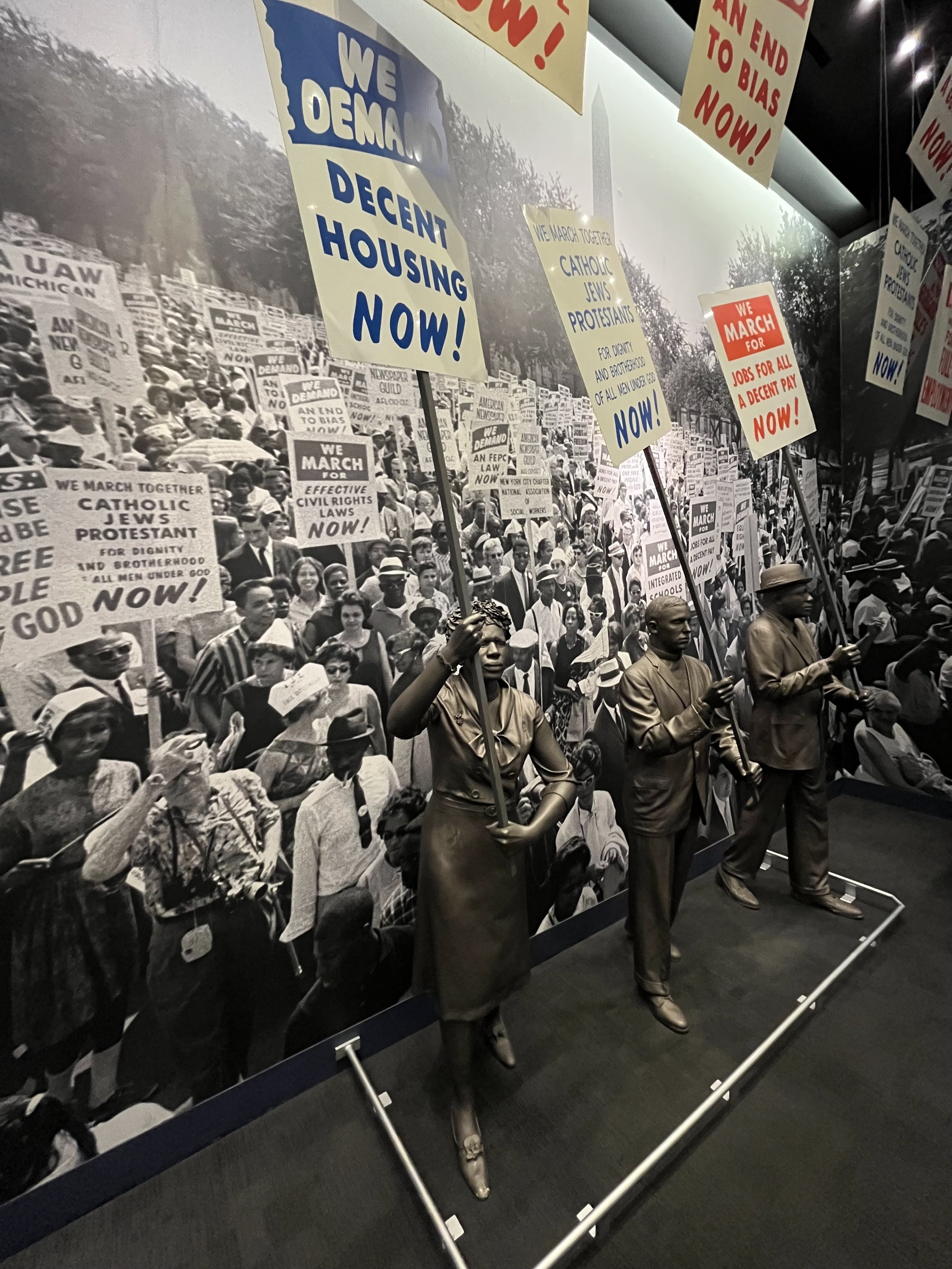
When John Lewis was a child, he apparently ministered in a similar way. Before he sought to make his life an instrument of peace during the civil rights movement, Lewis was the son of sharecroppers in the Deep South. On the farm, he would preach to the chickens. They were his congregation. He presided over their marriages, gave eulogies at their funerals, and baptized them.

What I love in those two pictures is the profound love of God and of God’s creation. They show individuals who see the world as an audience for the transforming love of God. Francis embodied the credo of preaching the gospel at all times even when words are not used. Though his childhood nickname was “Preacher,” Rep. Lewis did not serve in that vocation as an adult. But he preached. He put his life on the line believing that God’s love and justice was for all from birds to the people terrorized by a sinful system.

Red Stuff

Esau comes in from the field. He’s hungry. Famished. Starving so much that he’s near death, he says. Anyone who is a parent will roll their eyes at that familiar line. His brother Jacob is cooking up a stew. “Let me eat some of that red stuff.” That’s what it says in the NRSV translation: red stuff. Esau doesn’t always come off as the sharpest knife in the drawer.

Jacob on the other hand is probably too sharp for his own good. Jacob says he’ll give his brother the red stuff if Esau sells off his birthright. We go from red to Burgundy because, boy, that escalated quickly. Yet Esau is unaware of the elevated stakes. Again, he just thinks he’s about to die and thus sells off his birthright for some of the red stuff. Esau sells off his leadership of the family, the carrying on of Abraham’s responsibilities for a quick meal.

Red stuff. That’s a really evocative image. Red connotes power, passion, and violence; that’s stuff for which people will readily sell out who they are. Red is the easy shortcut. Red is the stop sign we fly past. There are these things that in the moment seem like they will make life so much easier, they will satisfy us, but they never do.

Give Us Rest

2020 is just over half over and it has been a lot. I don’t have to list it out for you. You’ve felt it. You’ve experienced it. It is unbelievably overwhelming. Just thinking about the rest of the year can seem daunting.

We don’t know when this pandemic is going to turn in the right direction, but we’ve got to keep trying to do the right thing even as the others do not. We do know that there is a long road we must walk in fighting white supremacy in our country. And who knows what else this year might throw at us? All of which does not even mention all the personal heartaches and sicknesses and fears that each of us face as individuals. It can sometimes seem like too much to bear.

So hear this word from Jesus:

Come to me, all you that are weary and are carrying heavy burdens, and I will give you rest. Take my yoke upon you, and learn from me; for I am gentle and humble in heart, and you will find rest for your souls. For my yoke is easy, and my burden is light.

Hamilton and the Idea of America

There are multiple times when EA and I were watching Hamilton last night when I felt my heart expand inside me. To be sure some of those moments revolve around the musical’s beautiful snapshots of love, camaraderie, parenthood, and forgiveness.

Yet there are also moments—primarily in “My Shot” and “Yorktown”—in which my heart swelled with pride for my country. As you see brave women and men of all ethnicities struggle for one another’s freedoms, you cannot help but think, “This is what it should be like.”

“Should be” is the operative phrase and it always has been. Hamilton is historical fiction (If you have a friend who is non-ironically wet blanketing people with this fact, pray for them because they don’t have much fun in life). With People of Color playing the founders of this nation, it is consciously more concerned with the Idea of America, where that idea has failed, and the continued struggle for it today.

A Psalm in Someone Else's Shoes

The psalms give us a language for praise and lament. Usually when I read a psalm of praise, my heart surges because I feel that praise towards God. When I read a lament it is because my own soul is downcast because others have hurt me or I have strayed in some way. Sometimes I will try to get in the mind of the psalmist. I’ll think about what that person was experiencing when they composed their cry to God.

But when I looked at this week’s psalm, it did not connect to my own experience and I did not find myself wondering what the psalmist might have felt. I immediately thought about the family of Breonna Taylor. She was murdered over three months ago and justice does not seem near.

How long, O Lord? Will you forget me forever?
How long will you hide your face from me?
How long must I bear pain in my soul,
and have sorrow in my heart all day long?
How long shall my enemy be exalted over me?

Here is what I wish my friends in the evangelical church would believe about me (for that's the only person I can speak of) as someone who has gone outside the doors of that brand of Christianity: It was never about leaving Christ.

When I finally had the guts to say that Black Lives Matter, support rights for LGBTQ+ individuals, criticize the ways American nationalism compromises the church, and push back against biblical inerrancy, I wasn't trying to leave something. I was trying to move closer to Christ.

I want to follow Jesus the best I can. Sometimes I am awful at it. I get things wrong. But to paraphrase a song: I want to be a Christian in my heart, my head, my actions. So very badly. And where I am is where the journey has taken me thus far.

I have not strayed. I have not left the church (in fact I work as a minister in a local congregation). I have not capitulated to culture or been brainwashed by the media. I have thought and fought and prayed and studied. Though it looks different I probably cling to God more now.