6,574 Days
I am 20 years old. It’s my birthday and the waning days of my sophomore year in college. In a fit of boredom that only occurs when you cross the socially acceptable randomness in college with a solid decade of watching David Letterman, I’m curious about what would happen to different objects if I throw them off the top balcony of our dorm building.
There’s this girl that I like. I think she likes me too. I’ve never been super confident about such things, but I’m pretty sure about this. I run up and tell her about my juvenile science experiment and she readily agrees to help me. I grab her hand as we scamper to the stairs. It’s the first time I ever hold her hand. We’re still a few months away from dating. Yet I still remember the electricity of holding E.A. Ferree’s hand for the first time.
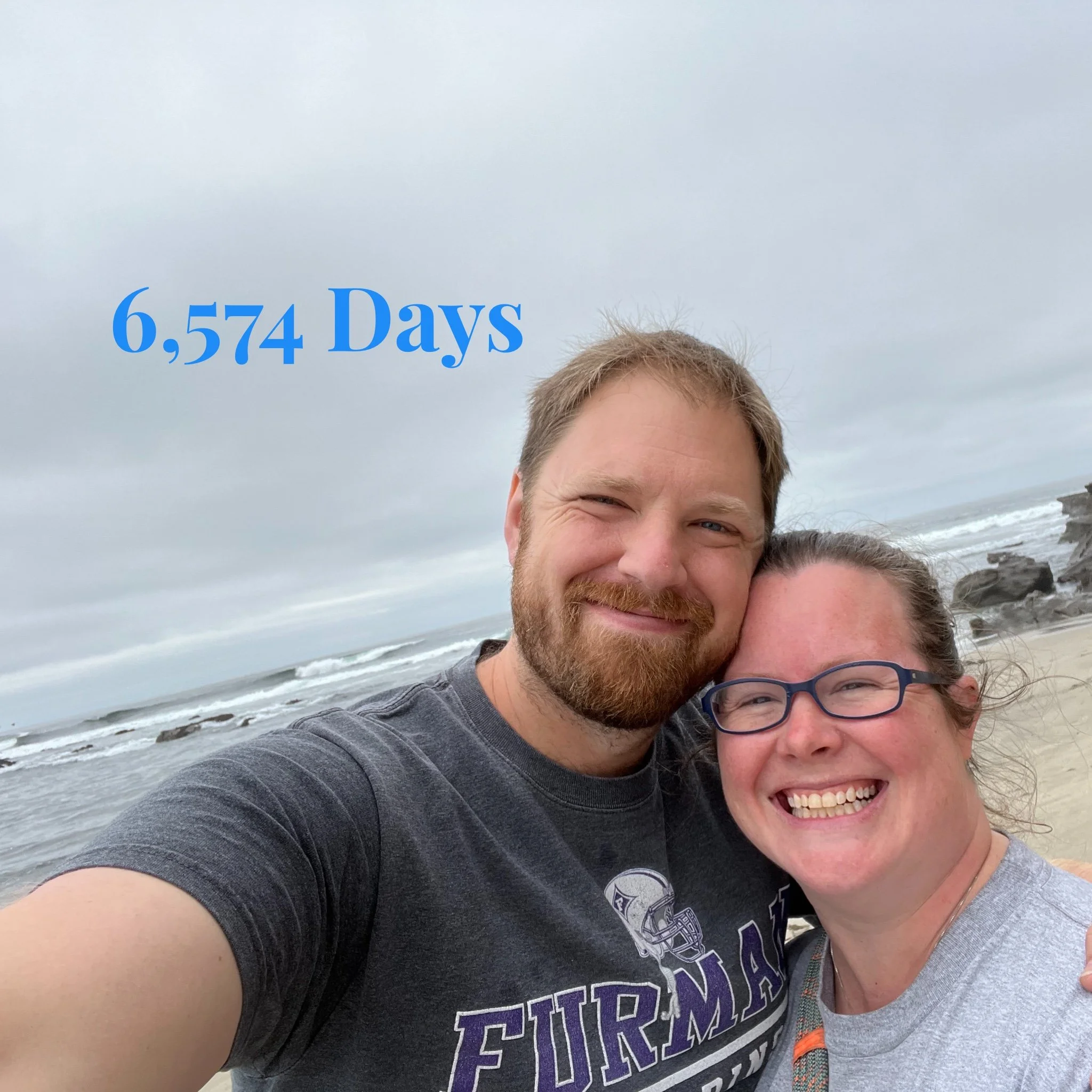
We are 40 years old now and today is our 18th wedding anniversary. We have been married 6,574 days. At some point this fall, we will hit the tipping point in our lives where we have been together as a couple longer than we have not. Which seems wild. I wonder what that 20 year old kid would think if you told him that he’d still hold that girl’s hand 20 years later and even then he would feel electricity. And he would feel home.
I cannot come close to adequately expressing what it means for me to be married to E.A., much less to have been married to her for 18 years. But, gosh, I am so incredibly grateful. She is still this girl, this woman, that I like. And miraculously she still likes me too.
E.A. and I have always gagged a bit at the idea that we are each other’s half. We are both whole people, thank you very much. What we do is make a pretty great team. We are a good team for our sons. We are a good team as we try to be humans in this world. Neither of us are perfect by any stretch, but we balance each other well and push each other in the best way.
There has probably not been a time in my life where I have been more sure of that truth than now. It’s been a rough year; the kind that can test your mettle. I cannot speak for E.A., but I know that she has been the one who has been there for me in some of my lowest points and believes in me in the moments when I have trouble believing in myself. There is no one I would rather have on my team than her.
Again, I am just grateful. I am grateful for the adventures. I am grateful for the ordinary days. I love when we get to ride in the car together and talk. I love that she indulges my nerdy ramblings just as I indulge her breaking down the latest true crime news. I love that she comes to me when she need help with Wordle and trusts me enough to ask my thoughts on the color scheme for her latest quilt. I love that she can interpret my sighs. I love when we make each other laugh. I love how we’ll send texts referencing jokes or songs that are part of our shared language. I love all the ways I have seen her be an incredible mom, youth leader, and teacher. I still love it when we hold hands.
I love all of this and more than I could ever write. I love you, Elizabeth Anne Cox. Happy Anniversary. Here’s to many thousands of days more.
I believe that most of us experience an internal tug-of-war between the past and the future. In The Screwtape Letters, C.S. Lewis’ titular demon supervisor advises his underling Wormwood that one of best ways to keep a human from doing good is to keep them ping-ponging between those two times that are not the present. One keeps trying to recapture or reach towards moments that are mist. It can keep a person from doing something.
The quote above resonates with me because it harnesses the past and unfinished future into a catalyst that animates our present. We remember the life, death, and resurrection of Jesus because it means something today and compels us to presently work for the Good that is already here, but also not yet. We remember the hope and pain of the past to do something that help us take some sort of step each and every day. We realize that the hope which exists within the gospel story is not yet fully realized. Many people are still being left behind and forgotten. The realization, as the theologian Metz states, puts pressure and questions on the present.