


Roots Then Wings
The idea was so perfect in my head. We would cap off our youth group about why worship matters with everyone writing their praises to God on a sky lantern, which we would light and send to the heavens. Up to God. The illustration wrote itself. The visual was going to be awesome. It was going to be impactful.
It was going to be illegal.
To release sky lanterns in Tennessee you have to have the same license as someone who does fireworks display.
That’s okay. We could do something else. Something else going up. Up. Up. Balloons. But balloons are bad for the environment. Do they make biodegradable balloons? They do. I was all ready to get some biodegradable balloons and helium and then…
“Many animals mistake burst biodegradable balloons as food causing intestinal blockage and death.”
It’s wrong to destroy God’s creation in an effort to praise God.
I had to let go of the idea of going up to God. It wasn’t until later that I realized that I had fallen into a common trap. I was thinking of God as being up.
Away.
Far from this earth.
The visual would have been cool. But it would have also fed this idea that God is not really with us, but hovering over us and not touching the earth. In talking about worship, I tried to stress two seemingly paradoxical ideas: God is immensely greater than we could ever imagine and that God cares intimately about us. For the latter to be true, God cannot just be sitting on high (which sidetone: God is not literally on high anyway). God has to be near to us. Even though God cannot be seen, God is not far away in the sky.
So instead we did something a little more grounded. We considered worship in light of the things in our life for which we wanted to praise God. Some wrote characteristics of God like the fact that God is always with us. Others wrote things of this world that God gave them whether it be family, friends, music. Netflix got a lot of shout outs. Which, to be honest, a mini-binge of some Parks & Rec reruns does seem like a divine gift after a long, hard day.
All of it was fairly simple. Some probably would have turned their noses up at the fact that we were talking about worshiping God because God gave us our family, our dog, or chicken tenders. They would probably say that you should just worship God because God is.
But you have to put down roots somewhere. God can sometimes be a difficult concept to grasp and so, “All of this that you love? God is the source of that!” seems like a decent place to start. If we are to worship God throughout our week and not just at church, it doesn’t hurt to remember gratitude towards God when we look at the everyday things in our lives that bring us joy.
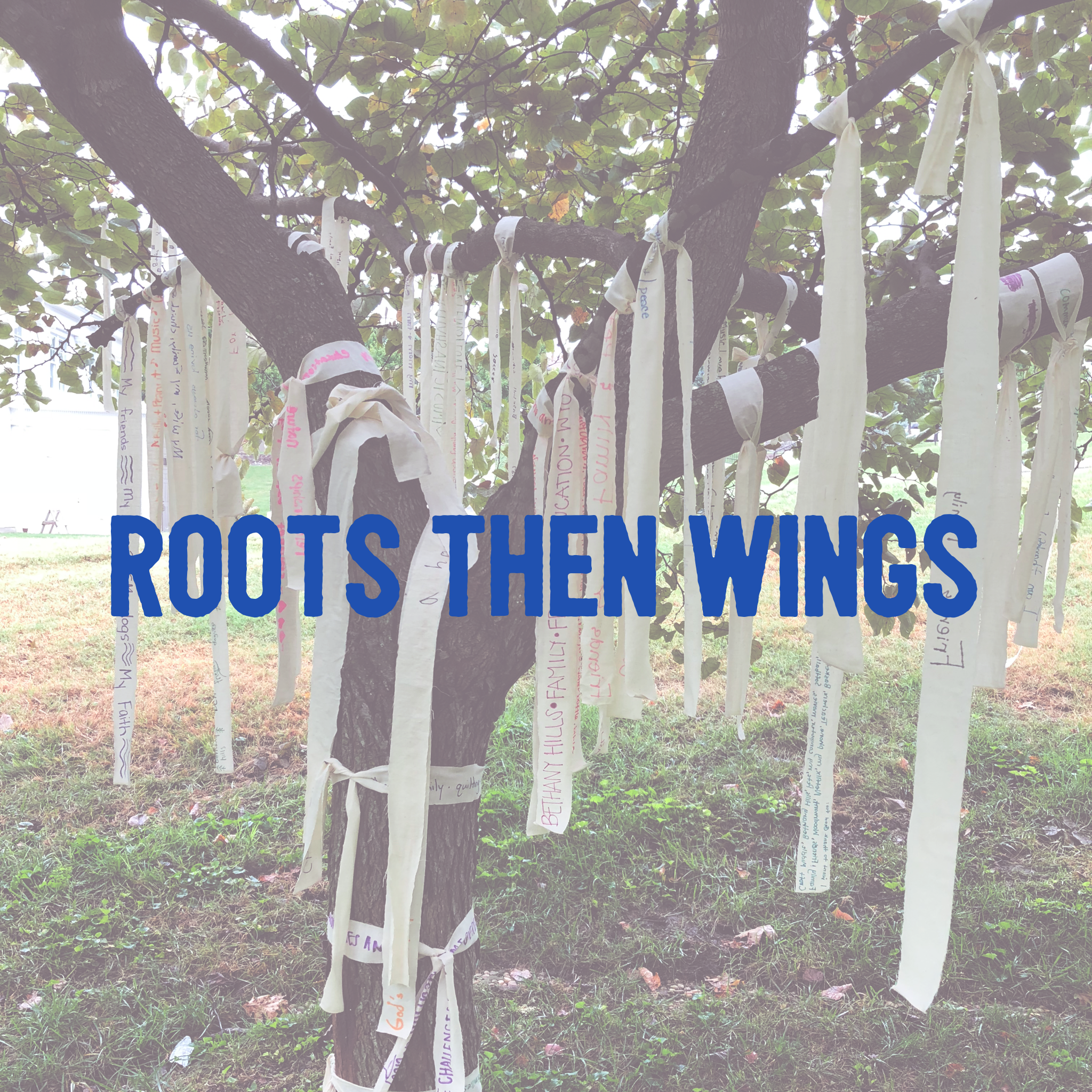
E.A. came up with the idea of writing these reasons for praising God on pieces of fabric. We took communion and then we tied the pieces of fabric to the branches of a tree that sits in an outdoor chapel at our church. I spoke briefly of the First Psalm and how it talks about how it says that the one who delights in the Law of God is like a tree planted by a stream. I said that I hoped that by seeing God in all of these things—whether it be God’s presence in their life or their love of their volleyball team—that they would be able to delight in God and grow in their love for God just as the tree would grow.
I’m glad my dreams of sky lanterns and balloons got thwarted. God is with us and not far away, bringing us joy in a myriad of ways; even the seemingly ordinary. It’s good to lay some roots down first.


I believe that most of us experience an internal tug-of-war between the past and the future. In The Screwtape Letters, C.S. Lewis’ titular demon supervisor advises his underling Wormwood that one of best ways to keep a human from doing good is to keep them ping-ponging between those two times that are not the present. One keeps trying to recapture or reach towards moments that are mist. It can keep a person from doing something.
The quote above resonates with me because it harnesses the past and unfinished future into a catalyst that animates our present. We remember the life, death, and resurrection of Jesus because it means something today and compels us to presently work for the Good that is already here, but also not yet. We remember the hope and pain of the past to do something that help us take some sort of step each and every day. We realize that the hope which exists within the gospel story is not yet fully realized. Many people are still being left behind and forgotten. The realization, as the theologian Metz states, puts pressure and questions on the present.