Awe and Wonder
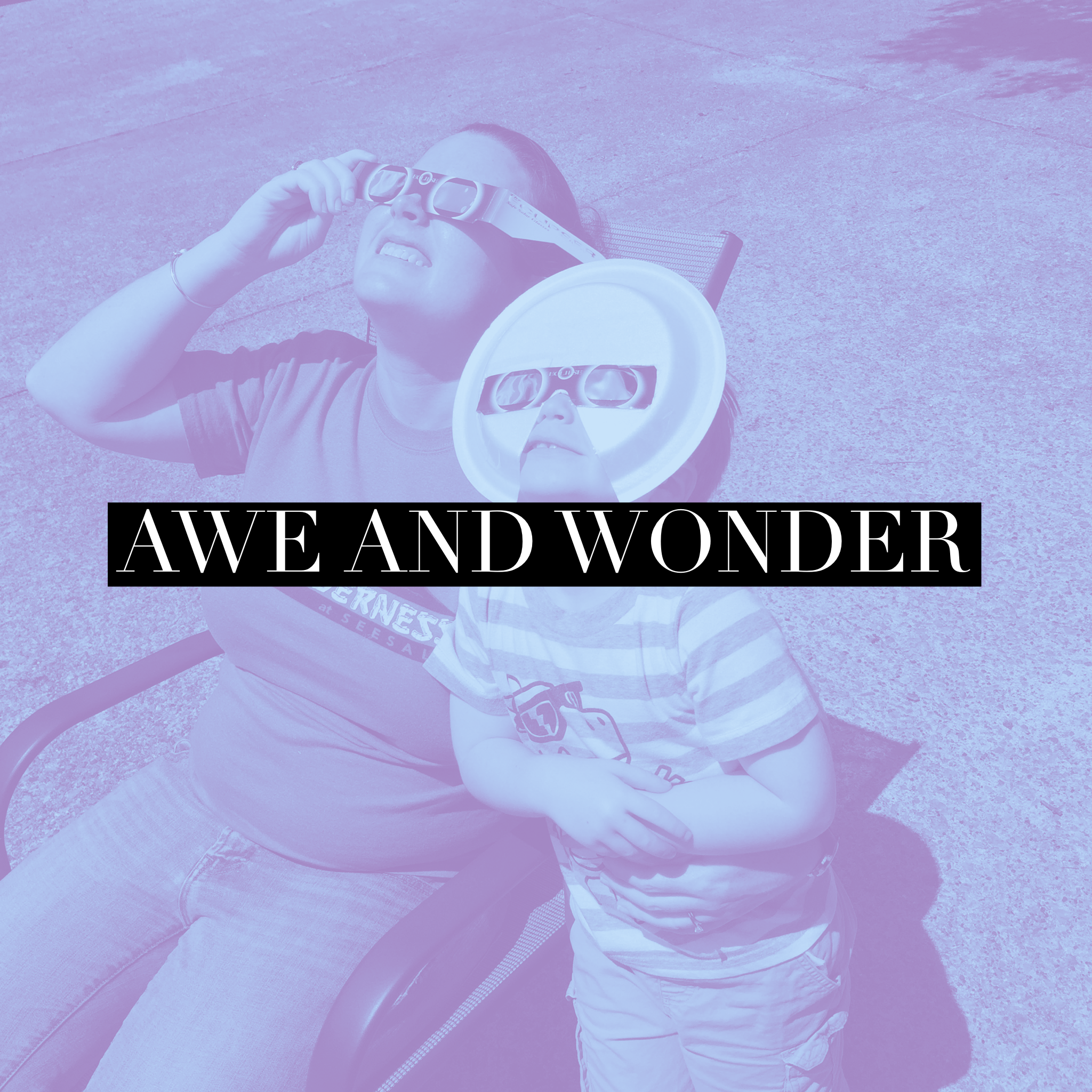
I knew the eclipse was going to be something special when I saw EA's face after first caught a glimpse of a sliver of the moon over the sun. She pulled off her glasses and her eyes were like that of a kid. It was like she had seen snow for the first time. Our faces don't beam with that kind of surprise so much when we're adults. That's when I knew.
The actual kids in our household were in awe also. Jim, our oldest, was beside himself for excitement. Schools in Nashville were off for the eclipse and they had been talking about the event at school. "THIS IS THE BEST DAY EVER!!!" he shouted. Granted it doesn't take much for him to declare a day as the best or worst ever, but he said this was the best more often than usual.
So we stood and stared at the sun through our eclipse glasses. We watched that sliver of a moon grow and grow. Eventually it hid enough solar real estate that the sun turned into a Carolina crescent. Then ultimately our solar system's great light disappeared into a sliver itself.
As we got closer, EA's parents and brother came out into the backyard. Her dad guided her 100 year old grandmother to a lawn chair. She remembers seeing a partial solar eclipse when she was a little girl in 1925, but never had she witnessed something like this. Imagine being on this earth for over a century and still getting to see something new.
The light began to grow unnaturally dim. It was unlike dawn or dusk. The crickets began to chirp as if it were evening and the air cooled. When totality occurred, we pulled off our glasses and I gasped. I can't adequately describe what I saw. The solar corona was this vivid halo of light around a dark disk in the sky. It looked more real than real.
For nearly two minutes, it was dark in the middle of the day. It was not pitch black light night because the sun was still up there. It was just hiding; light still peeking out from behind the moon. EA pointed in the sky. There were planets disguised as stars to our naked eye and I thought of that psalm: "When I look at Your heavens, the work of Your fingers, the moon and the stars that You have established; what are human beings that You are mindful of them, mortals that You care for them?"
And I was filled with wonder.
Wonder is truly the incredible thing about yesterday. Across a strip of the United States, everything shut down. We stopped our hectic, busy lives and we looked up to the sky. And we were were awestruck. I think people crave that. It's why millions drove to be in the path of totality. It's why they sacrificed the hours they would sit in traffic on the return trip home.
We will drive hours and wait all day for something amazing to happen. We yearn for wonder, for awe, to look up into the heavens and remember how small we are, how big this universe can be. I think remembering that can change a person. At least for a moment and perhaps that moment can be a seed for something bigger.
The light returned and our glasses went back on. Eventually we retired inside to escape the late August heat. Jim and Liam would periodically scamper out to see if the moon had finished its course across the sun until it was again a sliver like the one that had made EA's light up a few hours before. For the tenth time Jim exclaimed, "THIS IS THE BEST DAY EVER!!!" And it definitely was one of them.

I believe that most of us experience an internal tug-of-war between the past and the future. In The Screwtape Letters, C.S. Lewis’ titular demon supervisor advises his underling Wormwood that one of best ways to keep a human from doing good is to keep them ping-ponging between those two times that are not the present. One keeps trying to recapture or reach towards moments that are mist. It can keep a person from doing something.
The quote above resonates with me because it harnesses the past and unfinished future into a catalyst that animates our present. We remember the life, death, and resurrection of Jesus because it means something today and compels us to presently work for the Good that is already here, but also not yet. We remember the hope and pain of the past to do something that help us take some sort of step each and every day. We realize that the hope which exists within the gospel story is not yet fully realized. Many people are still being left behind and forgotten. The realization, as the theologian Metz states, puts pressure and questions on the present.