They say the definition of insanity
is to do the same thing over
and over again
expecting a different result
So I wonder if it's insane to hope
that things will change
26 dead in a Texas church
and I pray and I call my senators
and I watch my old TV shows
that comfort me and remind me
that this world can be kind
and I write words
wrestling with the violence
that visits us again
and again
and again
and again
and again
And none of it worked last time
None of it worked
the time before that
or the time before that
or the time before that
But I pray and call and watch and write
and hope that maybe
just maybe
this time will be different
That hope is a wounded beast
with broken legs
and bruised feet
but hope is all I can do
Maybe that makes me insane
But maybe insane hope
is the only thing that
can stand up to this
bloody insanity
Featured
Being a parent forces you to take a close look at yourself. Of course, you don’t have to be a parent to self-examine, but there is something about the reality that another living human is under your care and protection for the foreseeable future that makes you take stock of your strengths, weaknesses, and beliefs. For example, I used to think I was a far more patient person before I had kids; like superhumanly patient. And then a crying toddler shows you the folly of that belief. On the flip side, time has moved on and having two teenagers affirms that, yes, I am ridiculously patient and that has been a strength as a parent.
Among many other reorienting moments that came with parenthood was full acceptance of our LGBTQ+ siblings. That process began many years earlier. As someone who studied religion, I knew that the biblical case against these individuals was not nearly as airtight as I was previously led to believe. Science and stories from people gave strong indication that this life was not a choice. And I had met gay and lesbian folks who were good people. The old axiom that you will know a tree by its fruit applies here.
But the tipping point was holding a tiny infant who I loved more than I thought possible and knowing that I never wanted him to be ashamed of who he is. I did not want a potential future in which one of my children came out as something other than heterosexual with the fear that we would not love them. Not accepting my child was not even conceivably on the table. So we raised our kids to know that LGBTQ+ were beloved members of God’s creation.
There is this typical ice breaker question that is some variation of “If you could have dinner with anyone famous living or dead, who would it be?” And one of my steadfast answers for almost twenty years has been Stephen Colbert. Through both The Colbert Report and The Late Show, he has given hours upon hours of laughter and more than enough on which to ponder. I feel like we’d have a lot to talk about since we are both unabashed nerds, products of the Palmetto State, and he just seems like a good hang.
Beyond all of that, I appreciate how honestly and humbly Colbert approaches his faith. There have been numerous times over the years when his comedy and conversations take a turn into the spiritual that is challenging and convicting. I remember an episode of The Colbert Report where one minute he was making a joke about Ben Franklin’s predilection for French prostitutes and then organically made his way to the following quote:
If this is going to be a Christian nation that doesn't help the poor, either we have to pretend that Jesus was just as selfish as we are, or we've got to acknowledge that He commanded us to love the poor and serve the needy without condition and then admit that we just don't want to do it.
Then there are the interviews that he has conducted on The Late Show. Colbert has said that he sort of found the heart of his show when he had a conversation with then-Vice President Biden about grief. Indeed the loss of his father and brothers at a young age has led him to create an empathetic space to explore loss in the midst of celebrities promoting their most recent projects (my mind immediately comes to a conversation that he had with Andrew Garfield about the loss of the actor’s mother).
On the way to school, the youngest burrowed his head into my arm. “I don’t like that you’re getting older.”
“Why is that?”
“Because you’re one year closer to death.”
“There it is.” That’s my kid. Very sweet. Very sensitive. Brutally, bordering on inappropriately blunt. “Well, it’s better than the alternative.”
“Getting younger?” He thinks for a second. “Oh…dying.”
“Yeah, you can’t get younger.” I scratch him on the head. “And hopefully I have a ways to go. Ideally, I’ll still be kicking around when you turn 43.”
“You’ll be 73. So that’s reasonable”
“Yeah.”
“Granddad will be 103.”
“Less likely. But maybe. I hope he is as long as he’s happy.”
“And healthy. Happy, healthy, and alive.” Then he goes into a bit from an episode of Brooklyn Nine-Nine which makes me laugh.
Birthdays, as my oldest posited this morning, are kind of weird when you get older. Or at least they morph into something different from the second Christmas-esque excitement when you’re a kid. Because there does get to be that point where it creeps into your mind that you are a year closer to death. And that forces you take stock of your life which is a hit-or-miss affair due to being human’s volatility.
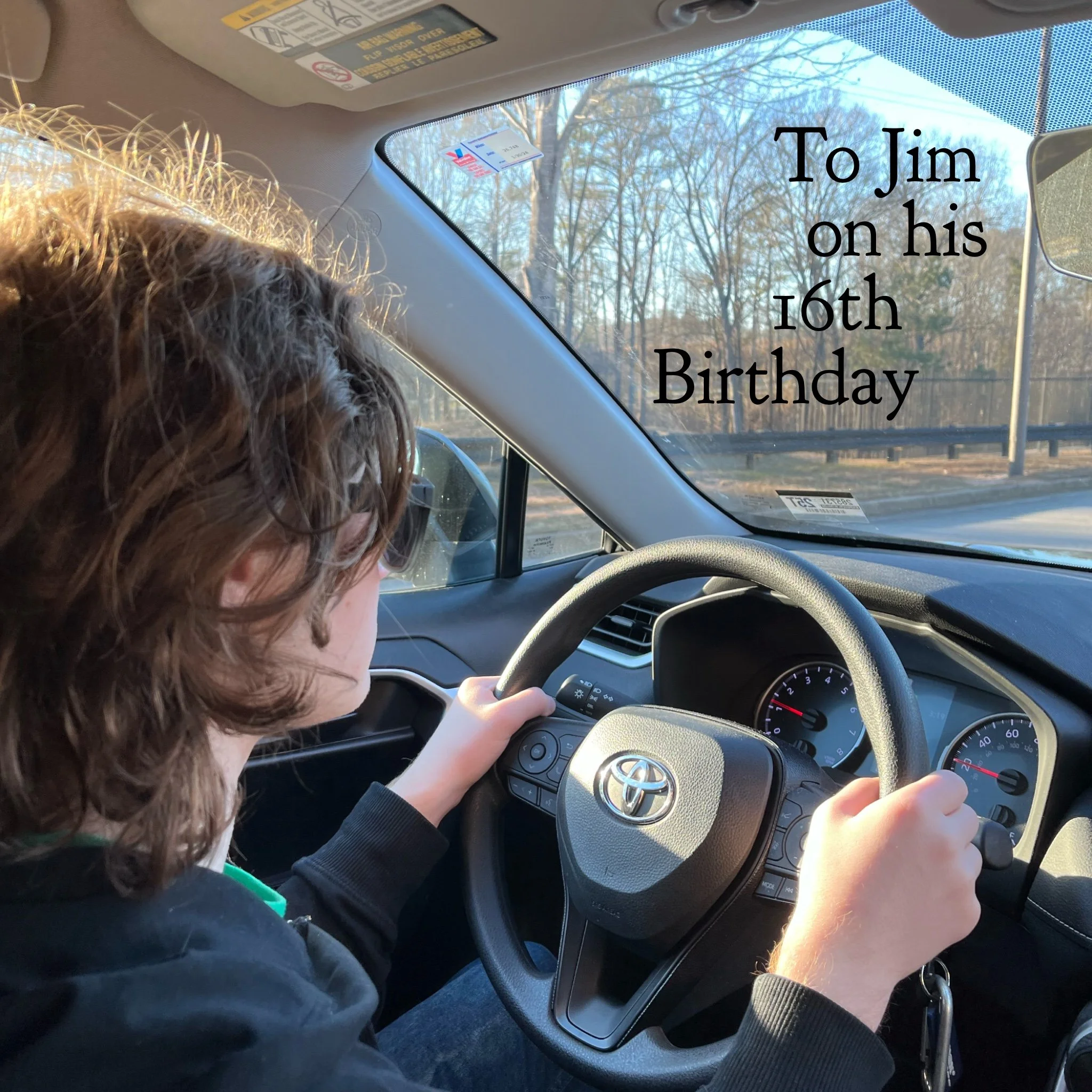
One day last week, I picked you up from school after took one of your AP exams and then I moved over to the passenger seat so you could practice driving. In the midst of being hyper vigilant about your speed, how quickly you stopped, how close you were to the side of the road, and what every single other car on the road was doing, I had a distinct moment of looking over at you and realizing that so much is changing. And we’re only at the start.
Today you turn 16. You are about to wrap up your sophomore year of high school. You’ll take a driver’s license test in just a few weeks. We have three more summers before you go off to college. There are times it seems like yesterday when you were sitting in the living room watching cartoons with a couple of dozen superhero toys. There are times it seems like last week when you were a newborn sleeping in my arms.
The feeling of you being 16 is kind of like being the passenger in the car while you are driving. I have a ton of confidence in you and trust you. And I worry about your lack of experience in a big, sometimes frightening world and whether I have taught you well enough. I am wary of everyone else on the road. I wonder if you are going too fast even though you are going an appropriate speed and I am the one who encouraged you not to go as slow in the first place. It is all very exciting, humbling, frightening, and new.
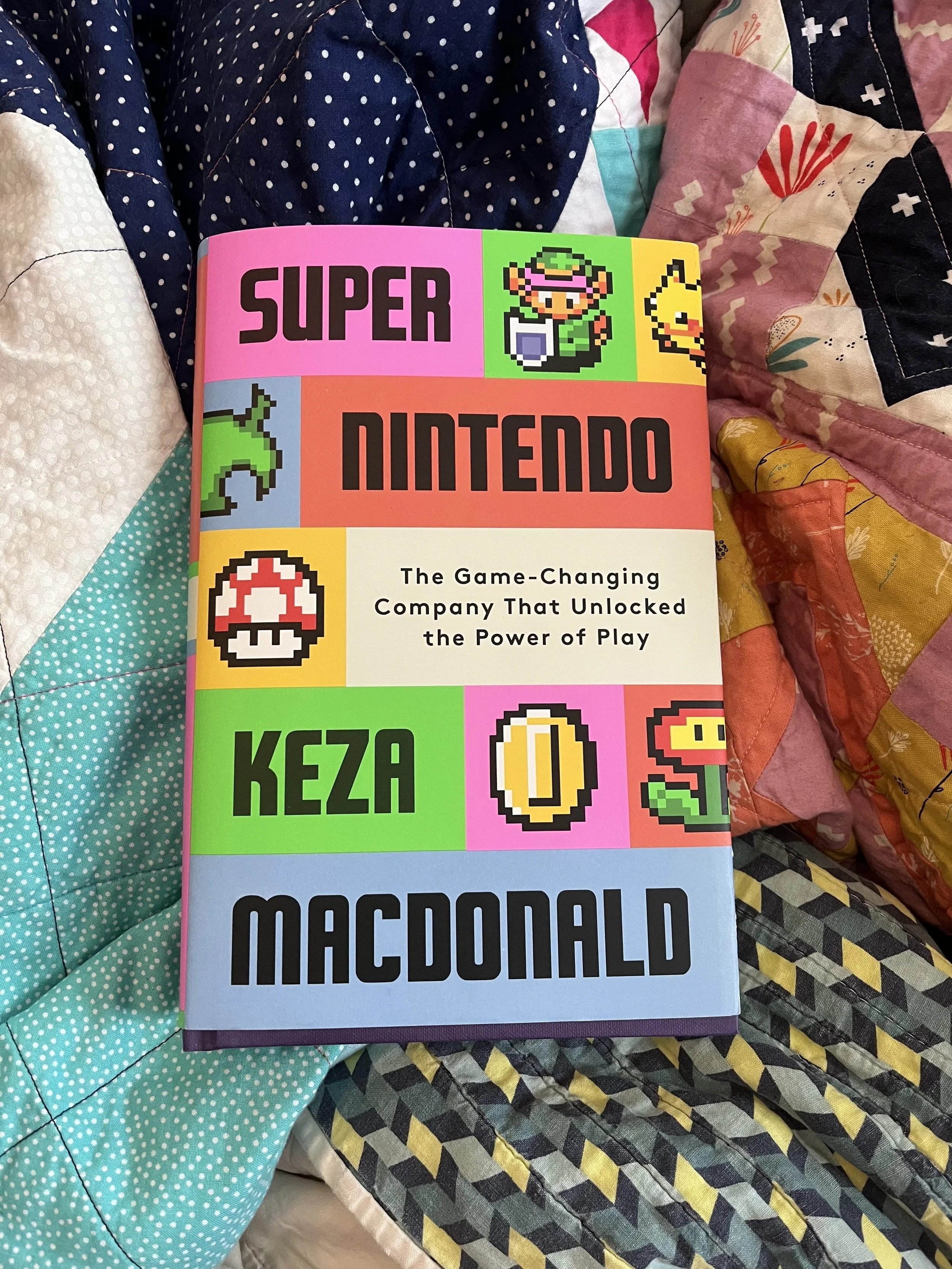
Christmas 1988. My brother Taylor and I receive the Nintendo Entertainment System packaged with Super Mario Bros. and Duck Hunt and we have been fans ever since. We have grown up with the Japanese company’s gaming systems; the adventures of Mario, Luigi, Yoshi, Link, Zelda, Donkey and Diddy Kong, and more have been a consistent presence in our lives. Even though we are in three different states now as adults, Taylor, my sister Shari, myself, and our kids will get together every so often and play Mario Kart online. We love Nintendo, which is a weird thing to say about a corporation that makes a billion dollars but it is what it is.
With all that said, I loved the Keza MacDonald’s book Super Nintendo: The Game-Changing Company That Unlocked the Power of Play. Not only is it an engaging journey through video game history through the lens of Nintendo’s iconic (and less iconic) franchises, but the book also has a great deal to say about creativity, community, and culture. In fact, it is that last idea that got me thinking about how this video game company can teach the church (or any other organization) even as I am a bit of an outsider to that world presently.
Here is one of two quotes that jumped out at me from the chapter “Splatoon” which looks at how Nintendo continues innovate and create over 40 years into its video game endeavors:
“Happy Easter?”
That is the first thing EA said to me as I woke up on Easter morning. I stretched and rubbed my eyes.
“I still believe in Jesus. It’s just the church that I’m not sure about.”
Some context: This was the first Easter in our 20+ years of marriage (and likely in either of our lives) in which we did not have a church to attend. It’s been about a year since we’ve gone to church as a family. Honestly, the church that we attended after I stepped down from working in a congregation had a tall order to tend to our hurting family. It was a good group of people, but the services and community never really clicked with our boys. Then early last year, I got moved to a Sunday morning shift. EA tried for a bit to go by herself but it wasn’t what she needed. In the end, I was gone for about eight months before anyone in the church really noticed and we decided to take a break.
I acknowledge my uncertainty about the church is a bit over-dramatic. Of course, there are great churches out there. There are wonderful people in congregations where my family and I have experienced the most pain. It’s akin to writing off burritos for life because you got violent food poisoning from one (This is based on a true story; I have not written off burritos just that particular Chipotle location). But the church hurt is real. As is the MAGA-fication of the denomination in which I grew up that feels so antithetical to the teachings of Jesus. So we don’t have a place to call home and it’s weird and sad and understandable.
Absurdist Note: I really want to add “Woo-ooh!” after the title. If you know, you know.
I have not pulled off this year’s Lenten disciplines the way that I set out to. When this 40 day period began, I set out to take on this fasts/spiritual practices:
Stop drinking Coca-Cola
Stop eating French fries
Stop playing Disney Solitaire on my phone
Do a daily devotional from Richard Rohr’s Wondrous Encounters
Write a blog five days a week
When the war in Iran began and threw another log on the fire that is the world, it pained me both spiritually and physically. One of the ways that played out was headaches and since headaches were already part of removing the caffeine of Coca-Cola from my life, I decided I probably shouldn’t compound a problem and began drinking Coke again. I have had French fries a few times; not many, mind you, but enough to break up the fast. There have been several multiple day stretches where I did not do my devotional. And my efforts to blog five times a week quickly fell by the wayside. I have managed to keep from playing Disney Solitaire, but that still puts my Lenten average in Mendoza Line territory.
Several hundred, some may say several thousand, years worth of anticipation hung thick in the air. Like summer humidity that sticks to your shirt the second you step outside, you couldn’t avoid it if you wanted to. Especially not during Passover week.
There was a guy making his way into Jerusalem; a guy claiming to be the Messiah. This was nothing new. He would not be the first that people claimed would save us. There had been tons of guys going around saying that they were the One; saying that they were going to show Rome what’s what. So a would-be messiah making his way to Jerusalem was about as common as a singer-songwriter making their way to Nashville.
But this felt different. He seemed different. Now there was a fair amount of debate whether he was the right or wrong kind of different. For starters, word got out that he had tried to keep a lot of the messiah talk and even tales of his miracles under wraps. But it is difficult to keep those kind of stories quiet: dead men walking, the blind seeing, demons plunging a herd of pigs over a cliff, and thousands fed from a lunch meant for a single kid. You can tell people to keep that hush-hush all you want, but it’s not going to happen.

In front of our house there is a branch that is barely hanging on to its tree. The limb is a casualty of the ice storm that tore Nashville earlier this year. As we cleaned up the debris afterwards, we tried to tear it off the tree as we did with a few other broken branches out front. But this branch was more stubborn than the others. So even though it is hanging on by a thread and nearly perpendicular with the ground, it remains as a reminder of a storm.
Now that branch is in bloom. Still hanging on by a thread, still touching the ground but now with flowers and the buds of leaves. It was a surprise at first. We did not really expect that branch to still be alive as it was barely connected to its source. But it is very much alive and now a symbol of beautiful tenacity. Even though it looks askew, I cannot imagine trying to rip that branch from its tree and I don’t think my sons would let me if I wanted to.


I believe that most of us experience an internal tug-of-war between the past and the future. In The Screwtape Letters, C.S. Lewis’ titular demon supervisor advises his underling Wormwood that one of best ways to keep a human from doing good is to keep them ping-ponging between those two times that are not the present. One keeps trying to recapture or reach towards moments that are mist. It can keep a person from doing something.
The quote above resonates with me because it harnesses the past and unfinished future into a catalyst that animates our present. We remember the life, death, and resurrection of Jesus because it means something today and compels us to presently work for the Good that is already here, but also not yet. We remember the hope and pain of the past to do something that help us take some sort of step each and every day. We realize that the hope which exists within the gospel story is not yet fully realized. Many people are still being left behind and forgotten. The realization, as the theologian Metz states, puts pressure and questions on the present.