


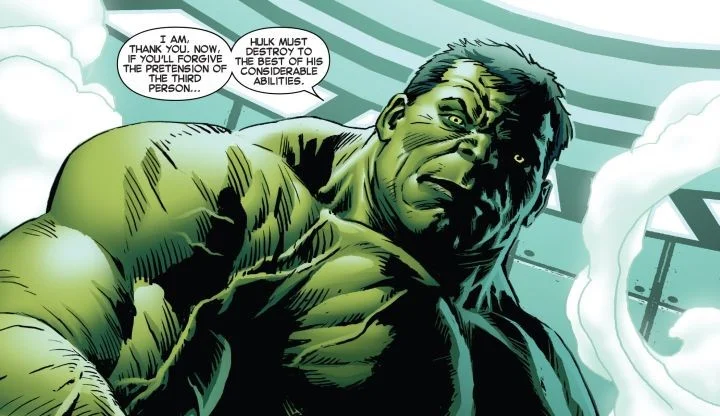
Each week, I take some time to reflect on one of the lectionary passages for the upcoming Sunday. This week for the third Sunday of Lent, we're going to look at the Gospel Passage: John 2:13-22. I'm actually preaching on this passage this week, but I wanted to take a brief moment to explore a tangent that I'm not actually discussing in my sermon.
I am afraid of getting angry. There are a few reasons for that. One: I'm an oldest child/peacemaker/people-pleaser. Two: people who get angry on cable news, the internet, etc. typically strike me as horrible, horrible people. Three: Jesus drew a line between anger and murder in Matthew 5. I know now that there is more nuance to that than the surface reading, but my initial childhood conception of "Holy cow, getting angry is the same as killing someone" is hard to shake.
I naturally have a pretty calm demeanor and, this is fairly silly, I have always been worried that fully expressing anger will turn me into an Incredible Hulk-like mountain of rage. Thus I avoid anger like the plague. I absorb. I let things seethe. Writing about it at this moment makes me realize that this all is likely incredibly unhealthy. But I have these deeply embedded notions that any expression of anger makes you an unlikable, ugly, sinful person. It's hard to unlearn that.
Yet here is Jesus in the Temple and he is angry. Sure we can dress it up in flowery language and say, "Well, he wasn't angry so much as he was zealous for God's House." Uh-huh. He made a whip and used it to drive people out. Sure that was zeal, but there was a hefty dose of anger in there too. We believe that Jesus was without sin. The majority of Christians would say that what he did was a good thing. But he was still angry.
Hmmm...
I mentioned the Incredible Hulk earlier. We all pretty much know his deal. Mild-mannered Bruce Banner gets angry, turns into a green behemoth, HULK SMASH, destroys everything in sight, and then back in his normal state Banner is horrified at the disaster Hulk left in his wake. It's basically a comic book version of Dr. Jekyll and Mr. Hyde.
Except there are a few stories in which Hulk retains his intelligence in his not-so jolly green giant form. It transforms him from this chaotic force of destruction into a being whose power can be better harnessed for good. Of course it's never that simple because it's a story and stories are driven by conflict.
Stick with me here: I wonder if Smart Hulk gives a simplistic nod to the type of anger Jesus demonstrates. It is this potentially destructive force harnessed in such a way that it can be good. It is an anger that does not control us, but an anger that catalyzes into something that rises above the initial outrage. It is an anger that spurs an individual into doing something productive. It is an anger that is more concerned with creation rather than destruction (though sometimes things have to be destroyed to be born anew).
There is a fine line here. Anger can master us. It can turn us into hateful, vengeful people. It can twist us into creatures who want to metaphorically or literally kill others. At the same time, it is a natural human emotion that is healthy to express. Ideally we voice that anger in a way that does not wound others and then channel that energy into a way in which things can be made better. If anger leads to revenge (an eye for an eye) then it's destructive. If anger can lead to ways in which we short circuit the cycle of anger (turning the other cheek, loving our enemies) then I think we're on to something.
Since I have long viewed anger with such wariness, I feel like I am a bit out of my depth here (and that's one of the reasons why I'm not preaching specifically on this idea). But I'm curious what others may think of the idea of constructive anger and how it may tie into what Jesus does in the Temple.
I believe that most of us experience an internal tug-of-war between the past and the future. In The Screwtape Letters, C.S. Lewis’ titular demon supervisor advises his underling Wormwood that one of best ways to keep a human from doing good is to keep them ping-ponging between those two times that are not the present. One keeps trying to recapture or reach towards moments that are mist. It can keep a person from doing something.
The quote above resonates with me because it harnesses the past and unfinished future into a catalyst that animates our present. We remember the life, death, and resurrection of Jesus because it means something today and compels us to presently work for the Good that is already here, but also not yet. We remember the hope and pain of the past to do something that help us take some sort of step each and every day. We realize that the hope which exists within the gospel story is not yet fully realized. Many people are still being left behind and forgotten. The realization, as the theologian Metz states, puts pressure and questions on the present.