
Matthew 4:15-17
Although I haven't done so this year, I like running at night during December. Darkened streets are lit up by Christmas lights on houses and in yards. Even though there are no more people out on the road, the lights make me feel less alone. The interesting the side effect is that the houses without lights seem barely visible. It's like they have been swallowed by a black hole. That's the interesting interplay between light and dark. The darkness makes the light shine more brightly. The presence of light makes the areas where there is darkness seem all the more dark.
I think the darkness at Advent is more pronounced because we spend so much time focusing on light, hope, peace, and joy. When evil does rear its ugly head, it seems exponentially more evil. When people are killed, when hatred and prejudice spreads around us, when children go hungry it wounds us even more during this time of year. Whatever form it takes, the darkness can unnerve us. It can cause us to give up hope.
And in despair I bowed my head
"There is no peace on earth," I said
For hate is strong and mocks the song
Of peace on earth, goodwill to men
"I Heard the Bells on Christmas Day" is based on a poem written by Henry Wadsworth Longfellow. The poet had been shaken by the darkness he witnessed during the American Civil War. His oldest son had been severely wounded in battle. Even away from the battlefield darkness seemed to creep into Longfellow's life: around this same time, his wife died in an accident.
The fact that his loss was so personal makes his despair resonate all the more. During the light of Christmas, Longfellow's life was engulfed in darkness. It would be quite easy for him to hear the songs of light and bitterly laugh at how their fantasy mocked their reality. Yet somehow, some way, the poet mustered this final verse:
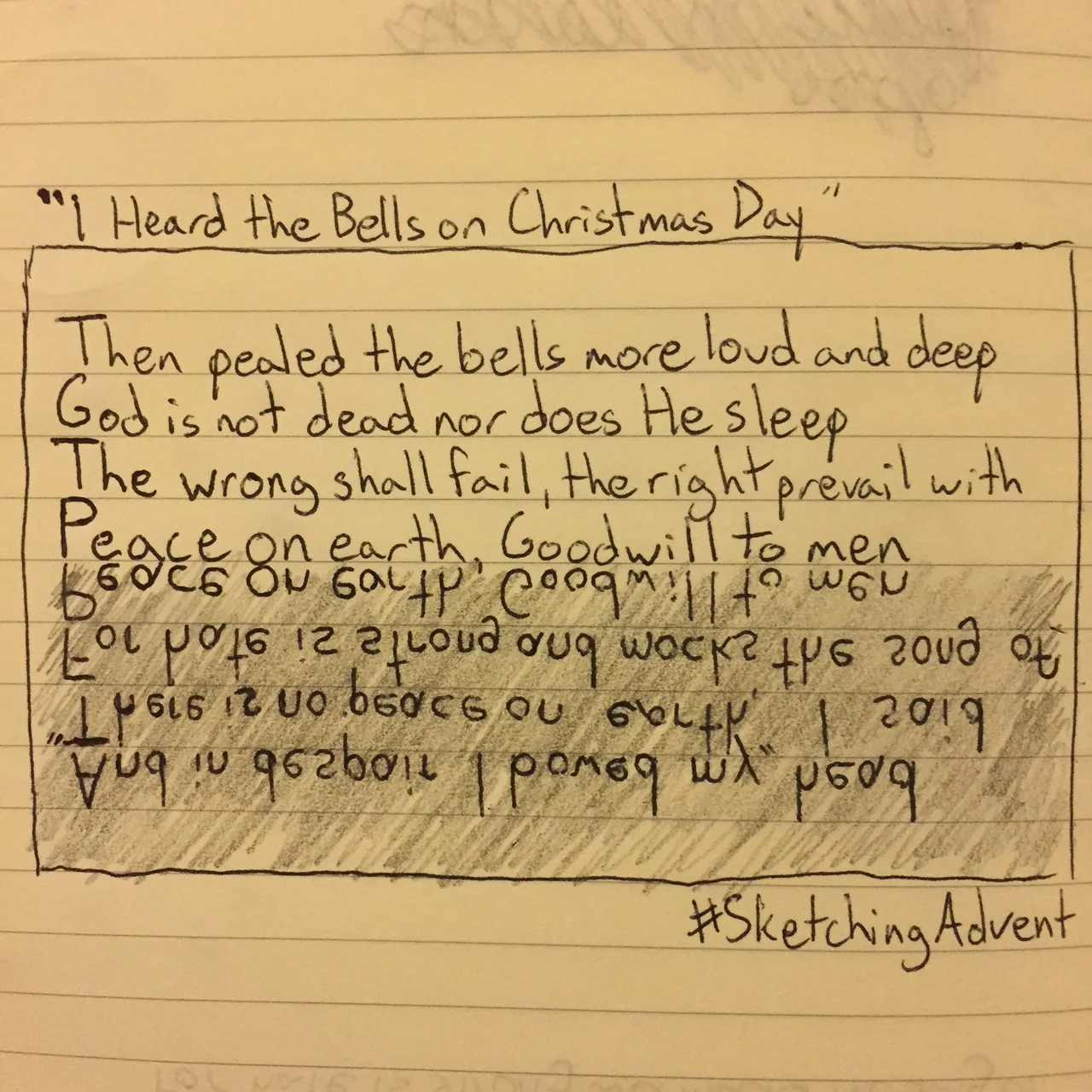
Then pealed the bells more loud and deep
God is not dead nor does He sleep
The wrong shall fail, the right prevail
With peace on earth, goodwill to men
In Advent and every season, may those bravely defiant words of hope be ours when the darkness seems to surround us.
I believe that most of us experience an internal tug-of-war between the past and the future. In The Screwtape Letters, C.S. Lewis’ titular demon supervisor advises his underling Wormwood that one of best ways to keep a human from doing good is to keep them ping-ponging between those two times that are not the present. One keeps trying to recapture or reach towards moments that are mist. It can keep a person from doing something.
The quote above resonates with me because it harnesses the past and unfinished future into a catalyst that animates our present. We remember the life, death, and resurrection of Jesus because it means something today and compels us to presently work for the Good that is already here, but also not yet. We remember the hope and pain of the past to do something that help us take some sort of step each and every day. We realize that the hope which exists within the gospel story is not yet fully realized. Many people are still being left behind and forgotten. The realization, as the theologian Metz states, puts pressure and questions on the present.