


Luke 21:25-28
I should probably just warn you that "A Charlie Brown Christmas" is going to pop a few times over the course of Advent. Why? Well, to keep it short: it is the only correct answer to the question "What is the greatest Christmas special of all time?" You are certainly entitled to other opinions, but those opinions are wrong.
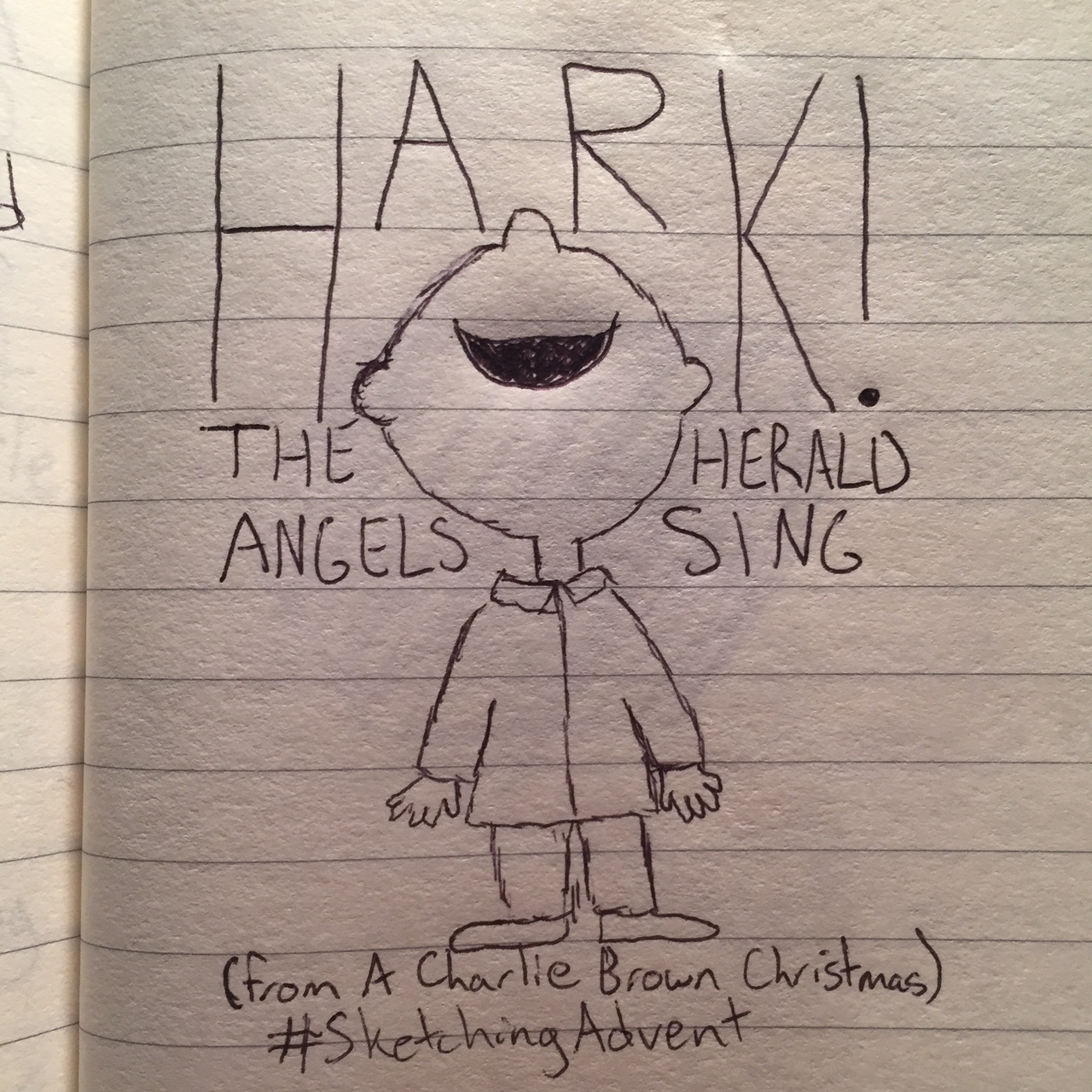
One of the many things I love about the special is its charming quirks. For example, when the Peanuts gang sings "Hark! The Herald Angels Sing" at the end, all of them tilt their heads back 90 degrees to where you can only see their mouth and nose. There is something childlike and therefore worshipful about that posture; as if Linus and the rest were trying to get the notes up to where the angels sang. I've always kind of felt we should sing "Hark!" in the same fashion. It'd be a literal pain in the neck, but it would imbue the song with a silly kind of joy.
The silly joy stands in contrast to the rest of the special because "A Charlie Brown Christmas" is for the most part a melancholy affair. There is still warmth, humor, and a fantastic moment that I'll get to in a few weeks. But nearly everyone is wondering what Christmas is really about and worried that the holiday won't live up to expectations.
When Charlie Brown lifts up his head to sing, in spite of the insults and existential crises that he has been through in the previous half hour, it is a cathartic moment. The act is hopeful and somewhat defiant. Christmas probably won't live up to the hype. Lucy is still going to be Lucy and call Charlie Brown a blockhead. The things that bugged and bothered him throughout the episode have not vanished. Yet he sings with joy. He hopes.
Luke 21 contains a section that seems an odd fit for Advent. Jesus is talking about signs of the Coming of the Son of Man. There will natural disasters, fear, and foreboding. Everything will seem to be falling apart. Then in verse 28, Jesus says: "Now when these things begin to take place, stand up and raise your heads, because your redemption is drawing near."
This world is often a dark, melancholic place. That reality can actually be amplified during the holiday season. Often things are so bad that people wonder if The End is coming. The reality is no one knows when this all is going to shut down. Yet in spite of the fear and the foreboding, we can trust that our redemption is drawing near. We can defy this world with its terrorism, xenophobia, greed, poverty, and so much more. We can hope that what Jesus says is true. Lift up your head and sing. Redemption draws near.
I believe that most of us experience an internal tug-of-war between the past and the future. In The Screwtape Letters, C.S. Lewis’ titular demon supervisor advises his underling Wormwood that one of best ways to keep a human from doing good is to keep them ping-ponging between those two times that are not the present. One keeps trying to recapture or reach towards moments that are mist. It can keep a person from doing something.
The quote above resonates with me because it harnesses the past and unfinished future into a catalyst that animates our present. We remember the life, death, and resurrection of Jesus because it means something today and compels us to presently work for the Good that is already here, but also not yet. We remember the hope and pain of the past to do something that help us take some sort of step each and every day. We realize that the hope which exists within the gospel story is not yet fully realized. Many people are still being left behind and forgotten. The realization, as the theologian Metz states, puts pressure and questions on the present.