Isaiah 40:27-31
"But I don't waaaaaaaant to waaaaaaaaaaaait!"
This is a common refrain in our household. Waiting is tough business for a five year old. Heck, it's tough business for a grownup. Yet here we are in Advent and waiting is one of the major themes. We have to wait. We are to embrace the wait.
But who really wants to wait? Waiting is a slog, a chore that we have to endure. I think in the church we sometimes emphasize the drudgery of waiting in Advent when we have four weeks of minor key renditions of "O Come, O Come Emmanuel." Don't get me wrong: the solemn anticipation is a vital facet of this season (and we'll get there), but it isn't the entire story.
One of my dad's favorite passages of scripture is Isaiah 40:31: "But those who wait for the Lord will renew their strength, they shall mount up with wings like eagles, they shall run and not be weary, they shall walk and not faint." Waiting, as difficult as it can be, is something that can renew us.
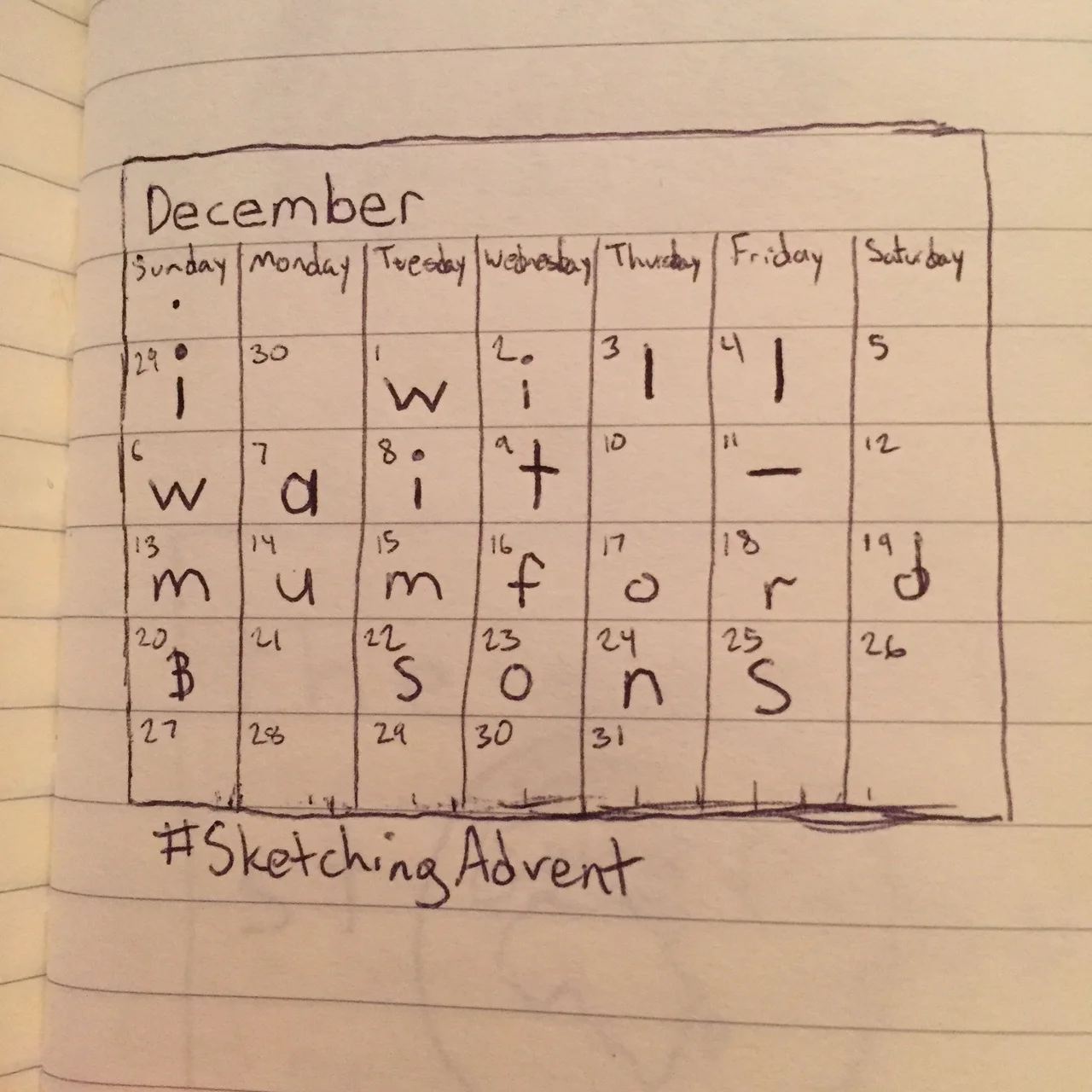
All of which is why I think "I Will Wait" by Mumford and Sons is a fantastic song for Advent. True, Marcus Mumford probably has a romantic relationship in mind, but religion is so much in the guy's DNA that it's easy to make the jump over to the spiritual. If part of what we do during this time of year is live in anticipation—not only of Christmas but God's redemptive work—there are many worse places to start than a song that declares:
So break my step
And relent
You forgave and I won't forget
Know what we've seen
In him with less
Now in some way
Shake the excess
By the time it hits the chorus, "I Will Wait" makes anticipation sound like a celebration; like it's one of the greatest honors that we receive as humans. Yet when we believe in the depths of our souls that the object of our waiting will not let us down, it can change us.
Now I'll be bold
As well as strong
And use my head alongside my heart
So take my flesh
And fix my eyes
A tethered mind free from the lies
When the song hits the final stretch, it absolutely soars. Perhaps in a world in which we demand to have everything right now, there is a cathartic freedom to waiting, choosing to wait, and trusting in the wait. All I know is that when Mumford those final lines of the chorus—"And I will wait, I will wait for you"—it sounds to me like someone kicked the doors of Advent in and let some light into the bleak midwinter. It makes me rejoice in waiting.
I believe that most of us experience an internal tug-of-war between the past and the future. In The Screwtape Letters, C.S. Lewis’ titular demon supervisor advises his underling Wormwood that one of best ways to keep a human from doing good is to keep them ping-ponging between those two times that are not the present. One keeps trying to recapture or reach towards moments that are mist. It can keep a person from doing something.
The quote above resonates with me because it harnesses the past and unfinished future into a catalyst that animates our present. We remember the life, death, and resurrection of Jesus because it means something today and compels us to presently work for the Good that is already here, but also not yet. We remember the hope and pain of the past to do something that help us take some sort of step each and every day. We realize that the hope which exists within the gospel story is not yet fully realized. Many people are still being left behind and forgotten. The realization, as the theologian Metz states, puts pressure and questions on the present.