You spend most of your early adulthood looking for a place that you can call a home of your own. The college years are spent bouncing back and forth between school and where you grew up. After graduation, it is theoretically off to that wide world and somewhere you’ll hopefully find a place to put down some roots.
EA, Jim, Obie, and I are leaving that place where we first deeply planted those roots. The move is not super dramatic. We’re staying in the same city and keeping the same jobs. The move is simply closer to town and to a bigger house to accommodate our growing family.
We bounced around a couple of times before landing in that house: nine months in Atlanta, a year and a half in my grandparents’ basement apartment. EA found the house in the late winter while Obie was still a puppy and beginning to wreak havoc in my grandparents’ backyard. We had been commuting to work/school a hour and a half total everyday. EA was interviewing for her first teaching jobs over in Spartanburg. She fell in love with it and showed it to me. I think we moved in around April.
The house was our first home home; the first place that felt like it was ours. A building is not necessarily what makes a place a home. It is usually the people and events that happen inside a building. But all of that memory has a way of seeping into the walls.
They breathe with the past. I walk into the bathroom where we discovered that EA was expecting both of our boys. There is the kitchen where we tried our hand at cooking Chinese food when we watched the opening ceremonies of the Olympics in Beijing. The office where one Valentine’s Day, I surprised EA with a picnic of Italian food and stringed bulbs in my best attempt to recreate Venice. The corner of the living room where our Christmas tree always stood.
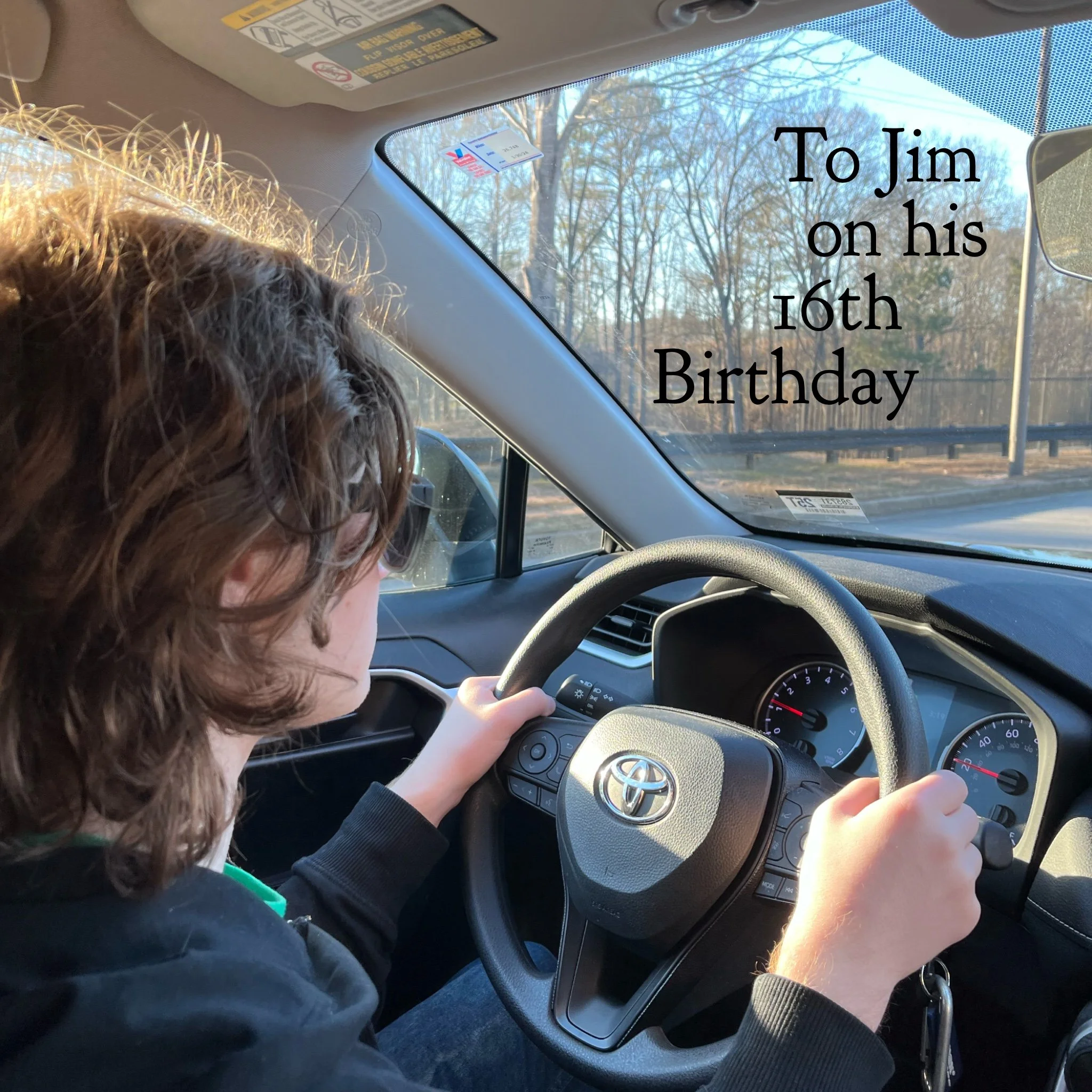
As I walked through rooms today, the one that probably made me stop the longest is the one that belonged to Jim. This is the house that we brought him home to and this was his very first room. His first bath was here. His first “ba-ba-bas,” his first snow, his first of one billion episodes of Curious George. These walls will always be his first home.
When a place is truly home, it can never feel completely foreign no matter how long it has been since you lived there. When my dad and I were in Columbia a few weeks ago, we drove through the neighborhood we lived in when I was two until about eight. Even though it had been twenty years, there was a twinge inside as I drove by our old house. I am writing this from what was my room for the bulk of my childhood. We’re staying at my old home until we can move into our new home. It is simultaneously weird and familiar to be here.
These last couple of days have felt like the end of an era. And with this new house a new one will begin. Somewhere in the next couple of weeks—hopefully after we’ve moved to our house—we will welcome Liam into the world. And then we will bring him to his new home and to ours.
I believe that most of us experience an internal tug-of-war between the past and the future. In The Screwtape Letters, C.S. Lewis’ titular demon supervisor advises his underling Wormwood that one of best ways to keep a human from doing good is to keep them ping-ponging between those two times that are not the present. One keeps trying to recapture or reach towards moments that are mist. It can keep a person from doing something.
The quote above resonates with me because it harnesses the past and unfinished future into a catalyst that animates our present. We remember the life, death, and resurrection of Jesus because it means something today and compels us to presently work for the Good that is already here, but also not yet. We remember the hope and pain of the past to do something that help us take some sort of step each and every day. We realize that the hope which exists within the gospel story is not yet fully realized. Many people are still being left behind and forgotten. The realization, as the theologian Metz states, puts pressure and questions on the present.