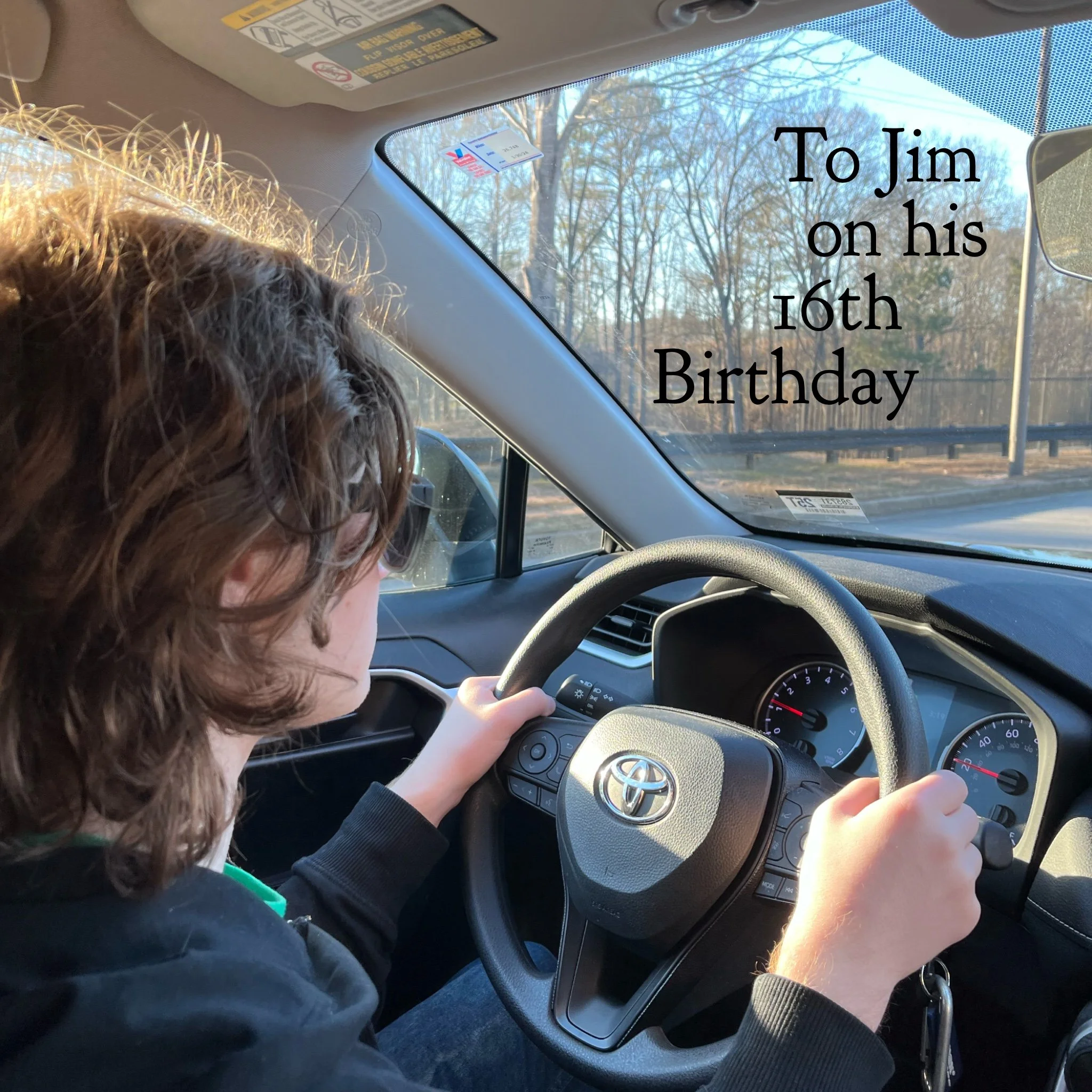

Wednesday was Jim’s first day of 2 year old preschool. Driving to the church on that day, I was praying for him—praying that he would be safe and that he would make friends among other things—and my voice caught just a little. This moment was harder for me than I had anticipated. After all, the preschool was just three hours a day at a church located less than a mile from where I work. It wasn’t like my son was moving away to Djibouti or anything. Yet here I was holding back tears.
I knew part of it is the old cliche of children growing up so fast. It’s true. In seemingly the blink of an eye, Jim has gone from a tiny, helpless baby to this energetic, smart, sweet little boy that runs and talks everywhere he goes. I’ve heard people comment about their young children that they don’t want them to ever grow up. I don’t want to do that, but I admit there are times when I wish we could keep a copy of him at this age.
I believe the main reason behind those emotions on Wednesday is that I am scared for him. I have complete trust in this preschool program. Yet there are now three hours everyday when I can’t protect my son. If he gets hurt—physically but especially emotionally—I can’t be there to scoop him up and tell him it’s going to be alright. I know that being able to deal with pain is part of growing up, but I don’t want Jim to be hurt. Yet it’s going to happen. It is simply a part of life.
So as much as I want to hold on tight to my son and never let anything happen to him, EA and I have to let go little by little. If we kept him in a bubble safe from the big bad world, he wouldn’t grow up to be the kind of man that can make a beautiful difference in this world. If we tried to shelter Jim from the world and somehow succeeded, it would prevent him from helping people when they are hurt.
So we have to learn how to be there for him even when we are not physically there with him. I know all of this cognitively. The execution of it will take some getting used to. Thankfully it unspools over a long amount of time albeit one that seems to go by quickly if the last two years are any indication.
I didn’t break down sobbing when I dropped him off. I was fine by the time we pulled into the parking lot. When we got to his classroom, Jim grabbed my finger and hid behind my leg like he normally does when there are unfamiliar people around. He looked up at me and said, “Daddy go read book.” So we read a short story about two dogs named Fred and Ted. When we finished, Jim said, “Imma gonna play with pillows.” And he was good. The kid is growing up. I’m so lucky that I get to watch it happen.
I believe that most of us experience an internal tug-of-war between the past and the future. In The Screwtape Letters, C.S. Lewis’ titular demon supervisor advises his underling Wormwood that one of best ways to keep a human from doing good is to keep them ping-ponging between those two times that are not the present. One keeps trying to recapture or reach towards moments that are mist. It can keep a person from doing something.
The quote above resonates with me because it harnesses the past and unfinished future into a catalyst that animates our present. We remember the life, death, and resurrection of Jesus because it means something today and compels us to presently work for the Good that is already here, but also not yet. We remember the hope and pain of the past to do something that help us take some sort of step each and every day. We realize that the hope which exists within the gospel story is not yet fully realized. Many people are still being left behind and forgotten. The realization, as the theologian Metz states, puts pressure and questions on the present.