


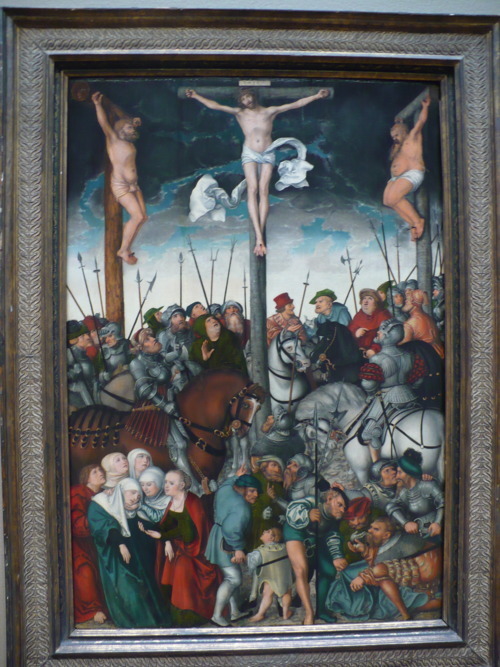
 The Art Institute of Chicago is a behemoth of a museum. In fact, our biggest mistake during our entire trip was not doing a better job planning our path through the works of Picasso, Van Gogh, Monet, Seurat, and others. Rest stops had to be made.
Perhaps the section that I found most interesting was that of the religious paintings that come from the medieval and Renaissance eras. The bulk of art for several centuries centered on stories from the Bible in a way that is unprecedented today. And, no, the bulk of the Jesus paintings people put on their Facebook walls today are not the modern day descendants of those works of art.
Seriously, they don’t count.
As we roamed the gallery with the only sounds being whispers and muffled footsteps echoing through the halls, I noticed something about the many crucifixion paintings: they were all very clean. There might have been a cut here and a drop of blood here, but for the most part Jesus was just a really, really pale individual hanging on the cross. He looked uncomfortable, but it wasn’t like he was experiencing something from which we get the word excruciating.
The other thing that I noticed was there weren’t too many paintings of the resurrection. That is not terribly surprising. For some reason or another, the cross is what our faith pivots on. That’s what is on top of churches. Yet there was something a little unsettling about it in the week leading up to Easter. Visually these paintings were telling a story, but the awful blast of Friday was accompanied by a near-silent whisper of Sunday.
I think that we sometimes live out our faith in a world of clean crucifixions and few resurrections. We don’t necessarily see the death of Jesus as sanitized as those artists did. True enough, it seems that the evangelical church of the Bible Belt prefers a blood-and-gore martyrdom of an action figure Christ. No, it’s clean in another way. It’s a transaction of “Jesus took my place, I believe it, and we’re done.”
And while that is part of the story, this easy ticket to heaven mentality ignores the call of scripture to die to ourselves, our sins, and our comforts. This clean transaction makes it easier to ignore the resurrection. Jesus did not come back just to show us that God can’t be beat. It was to show that God’s Kingdom was truly breaking into the old order ruled by sin and death just like Jesus had said all along.
The resurrection means a lot—more than I could comprehend—but I believe it means that and I believe we sometimes just leave Easter as a clean crucifixion transaction. It’s the same mentality where churches are super excited about getting people saved, but then do little in the way of discipleship to help people figure out how to live out this supposedly revolutionary way of life in the real world.
We forget the resurrection, because God resurrecting us in this world is a hard thing to wrap our minds around. It is also something that calls us to get our hands dirty. It means that even though Jesus took our place and we believe, we are nowhere close to done. Resurrection Sunday is the dawn of a new kingdom breaking through. We are called to live in that new kingdom, become the new people that are possible because of the life, death, and resurrection of Christ.
Otherwise, we’re just living in that Friday with a clean crucifixion, a transaction that asks nothing more than for us to punch a ticket to heaven. And if that’s the case, I would dare say we cannot call that Friday good.
I believe that most of us experience an internal tug-of-war between the past and the future. In The Screwtape Letters, C.S. Lewis’ titular demon supervisor advises his underling Wormwood that one of best ways to keep a human from doing good is to keep them ping-ponging between those two times that are not the present. One keeps trying to recapture or reach towards moments that are mist. It can keep a person from doing something.
The quote above resonates with me because it harnesses the past and unfinished future into a catalyst that animates our present. We remember the life, death, and resurrection of Jesus because it means something today and compels us to presently work for the Good that is already here, but also not yet. We remember the hope and pain of the past to do something that help us take some sort of step each and every day. We realize that the hope which exists within the gospel story is not yet fully realized. Many people are still being left behind and forgotten. The realization, as the theologian Metz states, puts pressure and questions on the present.