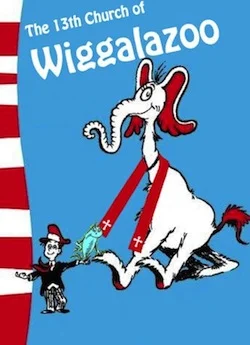
March 2 is the birthday of Theodor Geisel. On his birthday four years ago, I published this Dr. Seuss-inspired (primarily his If I Ran the Zoo) post about ecumenicism. I've updated it some. It is definitely not Seuss quality (the rhythms of his books are remarkable) and maybe more than a bit idealistic, but I hope you enjoy.
It was Sunday morning in Wiggalazoo
And a young boy was dreaming, as kids often do
Willie McGrew was pedaling his bike
When he noticed the churchgoers all looked alike
He thought about churches along Wiggalazoo Lane
And how folks stuck together with those who were same
They sang the same songs, they read the same books
They thought the same thoughts and had the same looks
Twelve churches in town and twelve bubbles they made
They did not mingle nor ideas did they trade
As he thought, an idea creeped up on Willie McGrew
What if a thirteenth church came to Wiggalazoo?
It’d be a place where everybody could go
Young and old, rich and poor, the fast and the slow
(“Slow?” you may ask. Well, it’s a rather long story
Involving the Speed Schism of Nineteen and forty)
Beyond barriers of class and the sociological
The church would welcome a variety theological
A place where Calfinfish, Armiants, and Wesselwats
Could worship together with Green Operaducks and Masstronauts
And instead of letting politics conquer and divide
The donkeyphant and elekey would stand side by side
Would they agree on it all? No, not in the least
Yet despite disagreements together they’d feast
Besides all of the rifts seemed especially lame
When the God that they worshipped was one and the same
Oh, how wonderful, how beautiful it’d be
To see every color in that community
The new things they'd learn, the new thoughts they'd think
When different folks gathered around a shared link
Perhaps the church services would be different too
There'd be songs from choirs of Silver Haired Ariloos
The Amperheads would rock out on their electric lyres
There'd be sermons and dramas, perhaps puppets, maybe fire!
It'd be a community of love, a community of grace
With no need for masks and all met face to face
They'd know church was people, not a building of bricks
They'd reach out to the hungry, the sad, and the sick
But would the church become like the other dozen?
Would outsiders be familiar as quite distant cousins?
Perhaps a new church was not the town's need
Maybe getting to know each other would plant that seed
They could reach out to churches along Wiggalazoo Lane
Could find common ground though they were not the same
They could do projects together. It'd be hard, but fun
As they found at the heart, they're all really one
What would happen? McGrew knew not what to expect
But such is the tension between the already and not yet

I believe that most of us experience an internal tug-of-war between the past and the future. In The Screwtape Letters, C.S. Lewis’ titular demon supervisor advises his underling Wormwood that one of best ways to keep a human from doing good is to keep them ping-ponging between those two times that are not the present. One keeps trying to recapture or reach towards moments that are mist. It can keep a person from doing something.
The quote above resonates with me because it harnesses the past and unfinished future into a catalyst that animates our present. We remember the life, death, and resurrection of Jesus because it means something today and compels us to presently work for the Good that is already here, but also not yet. We remember the hope and pain of the past to do something that help us take some sort of step each and every day. We realize that the hope which exists within the gospel story is not yet fully realized. Many people are still being left behind and forgotten. The realization, as the theologian Metz states, puts pressure and questions on the present.