

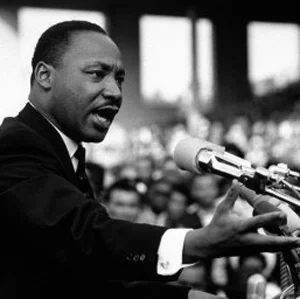
I had intentions of writing a reflection about Martin Luther King on, you know, Martin Luther King Day, but then a freelance project had to go back to square one, we got a flat tire on our car, and our oldest son got the flu. It was no great loss to the world that another white guy did not offer up a favorite MLK quote or tell you to read Dr. King's "Letter from Birmingham Jail" (though you should absolutely read "Letter from Birmingham Jail").
But I saw something on Twitter yesterday that has stuck with me. I do not remember who tweeted (and would love to give credit if someone can let me know who), but they basically said that MLK Day is perhaps one of the most Christian holidays that we have even if it is not so explicit.
And that's the thing about Dr. King. Even though he had his flaws (as we all do), when you look at his life, you witness a person who believes the gospel in a deeply profound way. You read his words and hear about the brave acts of non-violent resistance on the parts of those in the civil rights movement and it is like the Sermon on the Mount comes to life in technicolored brilliance.
The words of Jesus were not just esoteric spiritual matters to these men and women, they were a hope to which they pinned their very lives. They literally turned the other cheek. They literally prayed for those that hated them. And they showed that Jesus was not talking about some meek passivity that allowed the powerful to walk all over the weak. They showed that it was actually powerful resistance that speaks louder than violence ever could.
I wonder sometimes if we have made Dr. King too safe. I think we let him slip too easily into an inspirational figure, an almost mythical individual who helped slay the dragons of racism long ago. That distance means that we don't have to be challenged by him, by his peers. We can quote him once a year, but not really dwell on the message he preached and lived. Racism still exists. Poverty, war, rampant materialism, prejudice, and other issues close to his gospel-transfused heart still exist. I would do well to keep those things in mind, and act on them, more than once a year.
I believe that most of us experience an internal tug-of-war between the past and the future. In The Screwtape Letters, C.S. Lewis’ titular demon supervisor advises his underling Wormwood that one of best ways to keep a human from doing good is to keep them ping-ponging between those two times that are not the present. One keeps trying to recapture or reach towards moments that are mist. It can keep a person from doing something.
The quote above resonates with me because it harnesses the past and unfinished future into a catalyst that animates our present. We remember the life, death, and resurrection of Jesus because it means something today and compels us to presently work for the Good that is already here, but also not yet. We remember the hope and pain of the past to do something that help us take some sort of step each and every day. We realize that the hope which exists within the gospel story is not yet fully realized. Many people are still being left behind and forgotten. The realization, as the theologian Metz states, puts pressure and questions on the present.