


Note: Each Thursday, I'll be looking at one of the lectionary passages for the upcoming Sunday. Today, we're looking at Psalm 123.
"Supplication for Mercy"
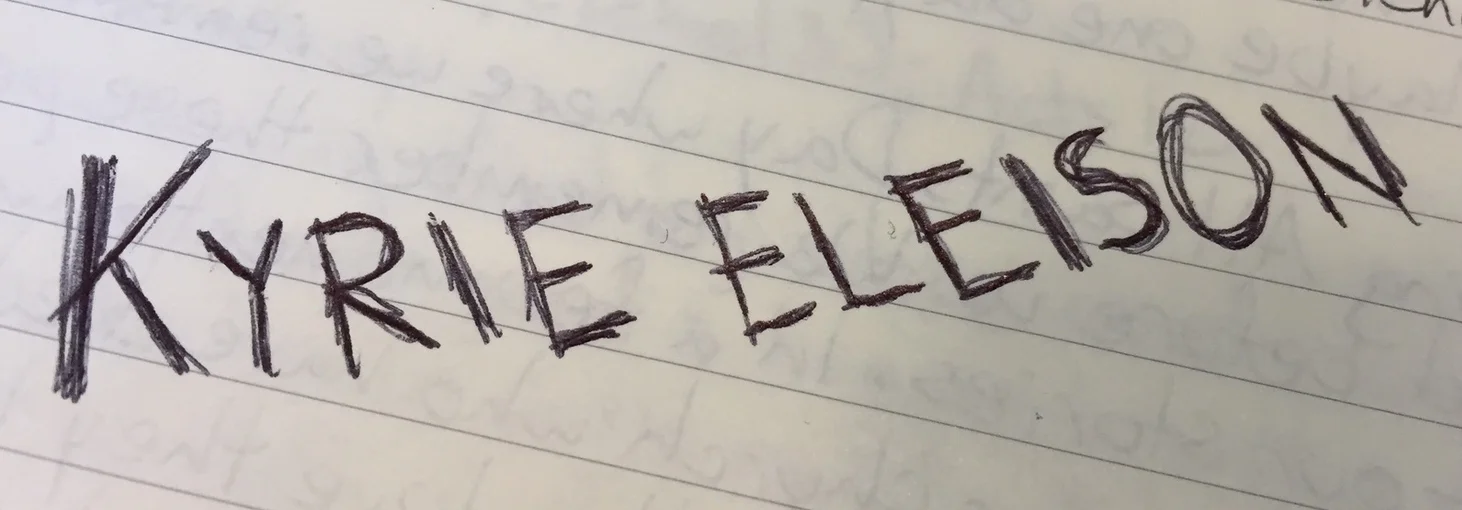
That is the title that my Bible gives to the 123rd Psalm. I cannot see the word "mercy" in the context of worship anymore without thinking about the Latin phrase Kyrie eleison which means "Lord, have mercy." That thought process is strange for a lifelong Baptist, I know.
Ever since I first heard that phrase ten years ago or so, there has always been something about it that has grabbed me. It may simply be that Latin sounds more cool (like a Harry Potter spell) or perhaps even more profound (I sometimes think English speakers have an inferiority complex). Yet I think that it goes deeper than that.
"Lord, have mercy." There is a vulnerability and a desperation to that phrase. I think I often equate asking God for mercy to asking God for forgiveness. That seems to be the context of most of the times I have heard the Kyrie in worship. In that case, "God, forgive me" just doesn't seem to cut as deeply for me. It sounds like the beginning of a transaction. I don't want to downplay that exchange. We are ridiculously fortunate that God does offer us grace and forgiveness.
When we ask for forgiveness, there is a tacit understanding that forgiveness will be offered. But "God, have mercy"? We know that we are completely lost without aid. When we ask for mercy, we are asking for whatever can possibly save us.
I also think that the Kyrie goes beyond the sin-righteousness dichotomy that we often assume makes up the totality of our relationship with God. Asking for mercy casts a wider net because sometimes we need mercy not just from the pain we inflict on ourselves but the pain we experience from others. That seems to be in the view of this passage's psalmist.
We sometimes receive more than enough contempt. We often find ourselves buried in scorn. It can come from anywhere: enemies, total strangers, and even friends. In fact, when those arrows of contempt are fired within the walls of the church then it hurts all the more. Humanity as a whole are creatures very skilled at wounding one another. We need mercy.
I think it is the desperation then that makes the Kyrie stand out. It is an utter dependance on God in which we beg God to show us some kind of light. God, have mercy. Rescue us. Save us from these dangers within and without; from our sin and the sin of others. There are times that we all make hell on this earth and there is only One that can turn the tide.
Lord, have mercy.
Christ, have mercy.
Kyrie eleison.
I believe that most of us experience an internal tug-of-war between the past and the future. In The Screwtape Letters, C.S. Lewis’ titular demon supervisor advises his underling Wormwood that one of best ways to keep a human from doing good is to keep them ping-ponging between those two times that are not the present. One keeps trying to recapture or reach towards moments that are mist. It can keep a person from doing something.
The quote above resonates with me because it harnesses the past and unfinished future into a catalyst that animates our present. We remember the life, death, and resurrection of Jesus because it means something today and compels us to presently work for the Good that is already here, but also not yet. We remember the hope and pain of the past to do something that help us take some sort of step each and every day. We realize that the hope which exists within the gospel story is not yet fully realized. Many people are still being left behind and forgotten. The realization, as the theologian Metz states, puts pressure and questions on the present.